
Woodrow Wallace’s Tobacco Operation, 1987-2001
Part 2: Harvesting, Hanging, Stripping, and Marketing the Crop
On this page . . .
This webpage describes the second phases of the crop cycle in Woodrow Wallace’s tobacco operation. The first web page describes the early phases and provides a brief introduction to Woodrow Wallace:
-
Woodrow Wilson Wallace
-
Preparing the seedbed and tilling the field for transplanting
-
Transplanting seedlings
-
Cultivating, fertilizing, and weeding
Tap to view trail sign
Introduction to part 2
ACLT’s South Side meadows were once farm fields. Here, as elsewhere in Southern Maryland, tobacco was the main crop until the early 21st century, when changes in land values and the labor force, together with a government buyout, brought cultivation to an end.
When tobacco farming was still active in Southern Maryland, it took 18 months to manage a tobacco crop from seedbed to the auction market, with stages for sowing, transplanting, cultivating, harvesting, curing, preparing the crop for market, and selling at auction. The earliest and latest segments in the crop cycle overlapped. When the seedlings for this year's crop were being sown, last year's crop was being readied for the auction market. Not long after the sale of last year's crop, this year's seedlings were transplanted to the main field.
These photographs of the Wallace family tobacco operation on ACLT land were made by Carl Fleischhauer from 1987 to 2001. They have been arranged to represent the lifecycle of the crop, regardless of the year in which a given photograph was taken. Fleischhauer wrote the text for this and the other webpage about the Wallace tobacco operation. [Endnote 1]

Transplanting from the seedbed to the main field, a topic covered in part 1 of this pair of webpages. Woodrow Wallace (1914-2002) drives the tractor while grandson William Edward "Bucky" Weems and son Sam Wallace ride the transplanter. Sam passed away in 2023. Photograph, 25 June 1988. CF_009-14.

Harvest time, a topic covered in this webpage. The men include Woodrow's son Waymon "Frankie" Wallace handing up the stick of tobacco at left (black cap, blue shirt), and the two men in the truck bed, Michael Wallace (shirt with red decoration), and Dave Evans (plaid shirt). 19 August 2000. CF_094-11.
Harvesting the crop (late summer)
Tools for cutting the stalks.
Left: Claude Brooks used a file to sharpen a homemade knife before cutting the tobacco plants, August 2000.
Right: Harvest tools at the edge of Woodrow's field.
At center, five homemade tobacco knives used to cut the mature plants;
at left, two tobacco sticks;
at the bottom, three spears. The use of spears is described below. August 1987.


Harvesting the crop.
The cut plants wilted in the field for a few days. Then they were speared onto sticks
to be hung in the barn.
Left to right: Derrick Parker,
Woodrow Wallace, Sam Wallace,
Gary Mason Jr., and Louis Waul III.
3 September 1988, CF_011-09.
Spearing the plants.
In the barn, plants hung on sticks. Each stick carried from five to seven plants, depending upon size. To load the sticks in the field, a spear was affixed to the tip and its sharp point impaled the thick part of the stalk, which was then pulled down onto the stick. After the plants were positioned on the "last" stick, the spear was removed and affixed to the "next" stick.
Left: Sam Wallace, 3 September 1988.
Middle and right: Bucky Weems.
3 September 1988.


Sticks to the barn.
The sticks were loaded onto Woodrow's pickup truck to be brought to the barn, where they would hang until late autumn or early winter, depending upon the crop and humidity levels. After curing was complete, the leaves would be stripped from their stalks.
3 September 1988, CF_013-08.
Hanging sticks of tobacco in the barn to cure (late summer)
Woodrow rented this barn near the intersection of Parkers Creek and Scientists' Cliffs Road for $250 per year. The owner was Henrietta Boots Commodore, a widow who then lived in Baltimore. Henrietta, born in Calvert County in 1909 and later married to Clarence Commodore, died in Stamford, Connecticut in 1993.
The barn measures about 60x24 feet and has 12-foot-wide doors. Woodrow said it had 16 rooms, as segments of the interior space are called. The rooms were defined by the tier poles (pronounced tire poles) that supported the tobacco sticks with their load of plants.
In 1988, Woodrow said that the plants he had harvested were big and, to give them enough air to cure, the sticks would be spaced 12 to 14 inches apart. With this arrangement, he said, a room would hold 150 sticks.

Commodore barn with pickup truck loaded with sticks ready to hang. 3 September 1988, CF_013-17.

Hanging tobacco.
Unloading the pickup: Louis Waul III, Dexter Holland, and Derrick Parker.
Hanging sticks, bottom to top: Woodrow Wallace, Sam Wallace, and Bucky Weems.
Sam and Bucky stood on tier poles as they hung the sticks.
3 September 1988, CF_014a-06, CF_014a-02.

At the September 1988 harvest, I watched Bucky Weems climb to the upper reaches of the barn, right under the roof. Placing the topmost sticks in place is called crowning the barn. Sam Wallace clambered about halfway up on the tier poles and handed Bucky sticks to hang. Sam got his sticks from Woodrow, who stood on a board between two sawhorses on the ground. Meanwhile, the younger men pulled sticks from the bed of the pickup truck, which had been backed into the south door, and handed them to Woodrow.
As the team worked, there was some concern about ground bees, larger than honeybees but smaller than bumblebees. One or two flew out of a pile of miscellaneous items on the floor and Woodrow cautioned us not to stir them up. "They'll eat you up," he said.
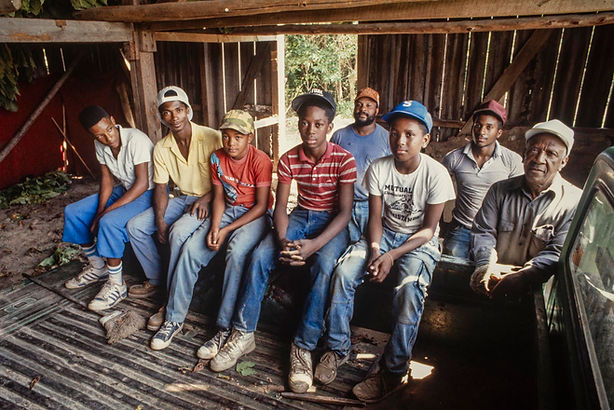
Harvest and hanging crew.
Front row: Dexter Holland, Louis Waul III, Gary Mason Jr, Derrick Parker, Johnny Weems, and Woodrow Wallace.
Back row: Sam Wallace and Bucky Weems.
3 September 1988, CF_104a-11.
Preparing the crop for market (winter)

Top left: The barn where tobacco hung and was stripped on a farm then owned by Henrietta Commodore. The former Commodore dwelling is at left. Bottom left: Plastic sheeting, rugs, and cardboard arranged to protect the crop and the stripping work area from rain and cold wind. Right: Hanging tobacco, sticks across tier poles. The arrangement of tier poles visible here defines three "rooms" in the barn. 20 January 1989.
At the Commodore barn, two or three windows had been built into the northwest corner of the barn to establish the stripping area. Thick plastic, rugs, and cardboard had been fastened to the inside of the walls in this corner to serve as a windbreak, and a half dozen poles (like the tier poles) were stretched across two sawhorses to create a stripping worktable.
My notes from the 1989 stripping operation describe a sequence of four steps, a loop that was repeated for the duration of the day's session. In Woodrow's absence, Sam Wallace managed the operation. Woodrow carried out step five on a subsequent day.

1. Get a batch to work with, still on sticks. Dave Evans, shown here, or Paul Parker went to the pile of sticks under plastic, selected a stick, lifted it, and with a single swift movement, pulled the stalks together at one end, which was then set on the floor. Plastic over the tobacco helped retain moisture to prevent them from drying and crumbling, in local parlance, keeping the leaves in order.
Dave Evans.
20 January 1989, CF_015-02.
Paul Parker.
20 January 1989, CF_015-08.

2. Remove the batch of stalks from the sticks. As the sticks piled up, one of the other men would take the batch, still on sticks, to the worktable. The table was fifteen or more feet long, aligned with the roof ridge, thus filling the westernmost segment if the barn. The tabletop consisted of a length of fencing or some other type of heavy wire mesh stretched across sawhorses.
The sticks-and-stalks were piled at the end of the table. Then one of the men held a stick while another man pulled off the bunched tobacco stalks to make a pile. The empty sticks were piled up to the side, available for next year's crop.


Far left: Dave Evans and Sam Wallace.
20 January 1989, CF_015-12.
Stripping scene, same place, different year. Sam Wallace, George Harrod (back to camera), Frankie Wallace, and Claude Brooks.
17 March 2001, CF_098-02.
3. Process the batch in a series of suboperations.
The first man was closest to the wall. Dave is shown in the photo at left above; in 1990, that slot was filled at other times by Paul. This man removed the leaves closest to the bottom of the stalk. Sam called them seconds. Then the stalk was passed to Sam, who removed the best leaves from the middle part of the stalk, called brights. (Some farmers also identify a not-quite-bright category called dull.) Finally, the stalk went to the third man, who removed the poorest quality, uppermost leaves. called the tips. The third man set the stripped stalks in a stack at the end of the table furthest from the wall. When the pile had been completely processed, the stalks were added to a growing accumulation along the north wall.

4. Tie leaves into hands. Each man took their leaves and tied a fistful together with a wraparound leaf. (The term was not used at this work session, but some farmers call these hands of tobacco.) The leaves are held at the stalk end, spreading out like a feather duster, and one free leaf is used to tie the hand together. After two or three turns around the hand of tobacco, the leaves in the bunch are pulled apart enough for the end of the wrapped leaf to be pulled through the middle, using friction to secure the hand. The finished hands were stacked in piles by category (seconds, brights, tips) and covered again by plastic to keep them in order.
Sam Wallace ties a hand of brights. 27 January 1989, CF_015-11.

5. Arrange and compress the hands. On a later day, Woodrow came and carried the hands to the other end of the barn. By category, he piled them on baskets for eventual transport to market. Each basket was surrounded by a set of sticks to keep that circle of hands aligned. Each stack was topped by another basket and a large cement block that compressed the pile as much as possible. These too were covered with plastic to keep the tobacco in order.
Compressing tobacco for market. 27 January 1989, CF_016-09.

Meanwhile, after the harvest, Woodrow had planted a cover crop in the field. He generally planted rye or wheat; the 1989 cover crop was wheat. Cover crops help control erosion caused by wind or water and add nitrogen to the soil for use by a subsequent crop. They were mostly plowed under but some material remained on the surface as a mulch for water conservation or retention.
In April, Sam and two of the boys brought the bare stalks from the stripping operation and spread them into the cover crop. Woodrow said he planned to plow the cover crop and stalks into the soil in a week or two. He waited until the cover crop was about 12 inches high. If it had gotten higher, he said, plowing would have been more difficult.
Tossing stalks onto the cover crop. April 1989, CF_023-12.
About a month earlier, I had noticed a small crop of turnips growing along one edge of the field. Woodrow said that he had planted them in late summer, for food. He usually pulls them up around Thanksgiving and stores them in a cellar or covers them with soil, which keeps them from freezing. But in 1988, Woodrow forgot to harvest them. Left in the field, many became soft and unpalatable. He had spotted them at Christmas, he said, and was picking the good ones. The Wallaces cooked them "like white potatoes," sometimes mashing them and seasoning with bacon or fatback.
Turnip crop. March 1989.

Transporting the crop to the auction market (spring)

The 1990 tobacco auction in Hughesville was active in mid-April. On Friday, April 13, Woodrow arranged for his friend Clarence A. White, a farmer who lived near Broomes Island Road, to bring his flatbed truck to carry Woodrow's 16 burdens (also called baskets) of tobacco to the Farmer's Warehouse in Hughesville. A crew of four fit young men loaded the truck at about 6:30 am before they headed on to their regular jobs. Woodrow and Clarence fastened the load with straps.
Loading burdens at the Commodore barn, April 13, 1990. At right are Woodrow Wallace and Clarence White.
Woodrow and Clarence started for Hughesville and I followed in my car, photographing the truck as it made the left turn in front of Dorsey Gray Ford in Prince Frederick (today's Prince Frederick Ford) and crossing the Patuxent between Hallowing Point and Benedict.


Departing from the Commodore barn, passing Dorsey Gray Ford in Prince Frederick, and crossing the Patuxent, April 13, 1990. Barn photo, CF_037-02.

Here's the Farmer's Warehouse, photographed on Wednesday, April 18. Wednesday was the customary day for the Amish to bring their tobacco in horse-drawn wagons, with Charles County sheriff's deputies keeping an eye on traffic and helping the wagons cross the road.
Farmer's Warehouse (tobacco auction market site), Hughesville, Maryland, with Amish farmers, Wednesday, April 18, 1990. CF_039-03.
Auction market, Hughesville (spring)
On Friday the 13th, Woodrow's tobacco was brought inside and weighed, then moved to join other burdens on the warehouse floor.
A warehouse worker brings one of Woodrow's sixteen burdens to the weigh-in station at Farmer's Warehouse, April 13, 1990.


I attended the auction on April 18. The event was ambulatory, with about two dozen people strung out along the narrow passages between rows of tobacco. The lead group included the the warehouse owner and two critical players hired by the warehouse: the auctioneer and a man who called out the suggested opening bid. In their orbit were six or eight bidders, followed by several farmers who tracked the vigor of the bidding and the range of bids. A woman who worked at the warehouse came a short distance behind the group. She filled out the paper tobacco tickets that indicate the winning bid for a given lot and fastened them to that burden. If they accept the bid, farmers leave the tickets as-is. If they decline, they tear or fold them.
Farmer's Warehouse, Hughesville MD, April 18, 1990, CF_040-04
The owner of Farmer's Warehouse was Jimmy Schultz, who wore a maroon sweater and kept an eye on things on behalf of the farmers he represents.
Farmer's Warehouse, Hughesville MD, April 18, 1990, CF_040-05


At far left in this photograph is the man who called out a suggested starting bid, often called a warehouse man in tobacco auctions in North Carolina. The auctioneer is behind him wearing a navy blue cap and jacket that had "World Champion Auctioneer" stitched on the back. The voices of these two men provided the soundtrack for the event. (Both came to this market from their home base in Columbus County, North Carolina.) The warehouse man called out phrases like "sixty-five" as a shorthand for $1.65 per pound. In counterpoint, the auctioneer chanted the current and next-higher prices with added encouragements to bid. On both sides of the row of tobacco, the bidders responded to the auctioneer with hand signals. The chant and the action was fast, impossible for a lay person to follow and understand.
Farmer's Warehouse, Hughesville MD, April 18, 1990, CF_040-06.
Woodrow's tobacco had not yet come up for auction on April 13, but he took a look at the tickets on some of the lots that had been sold.
Woodrow's tobacco was sold on April 18. He gave me a copy of the payout slip from the market. It listed 16 bundles totaling 1,866 pounds, with prices ranging from $1.60 to $1.70, and a net payment (after fees had been deducted) of $2,858. All things considered, Woodrow said, not a bad outcome for his 1989 crop.
Woodrow Wallace's Sale Bill, April 18, 1990.
Right: To judge the market, Woodrow checks the bid on another farmer's ticket, April 13, 1990. CF_039-15.

Endnotes
-
This text benefited from information provided by The Money Crop: Calvert County After the Tobacco Buyout (2005) by Anne Sundermann. The book was published by the Maryland Historical Trust Press and the Calvert County Historic District Commission. Additional information was provided by Michael Phipps.