
Woodrow Wallace’s Tobacco Operation, 1987-2001
Part 1: Planting the Seedbed, Transplanting, and Cultivating the Crop
On this page . . .
This webpage describes the first phases of the crop cycle in Woodrow Wallace’s tobacco operation. A second web page describes the later phases in the cycle:
-
Harvesting the crop
-
Hanging the crop in the barn to cure
-
Preparing the crop for market
-
Transporting the crop to the auction market
-
Auction market, Hughesville
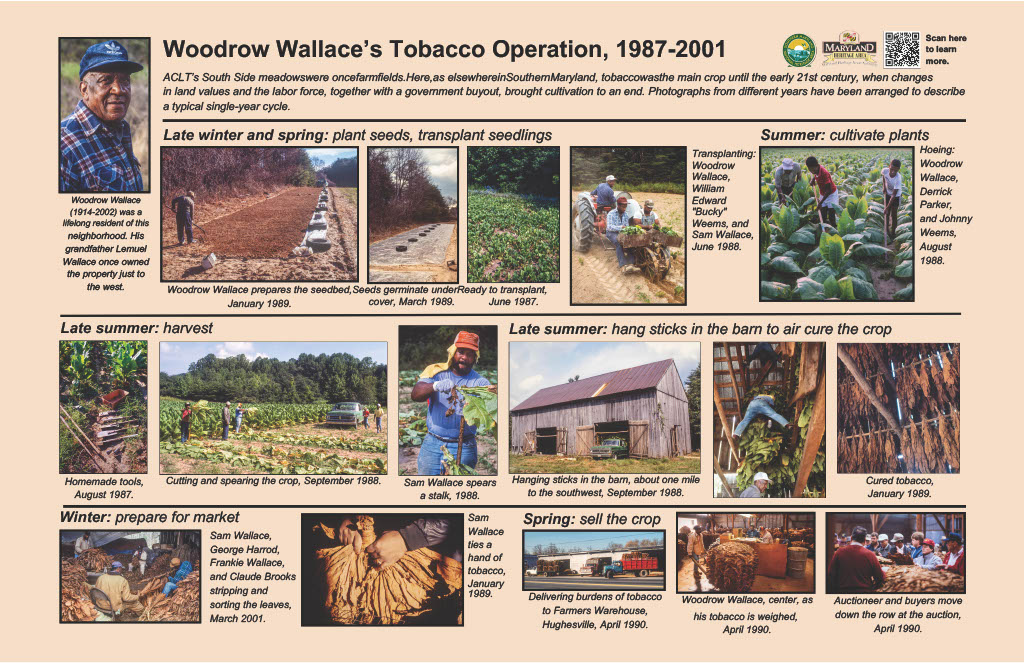
Tap to view trail sign
Woodrow Wilson Wallace

Woodrow Wallace, April 1988. CF_008-11.
Woodrow Wilson Wallace (1914-2002) lived in Port Republic for his entire life, mostly at a family home on the bayside lane now named Scientists Cliffs Road. Woodrow was one of the twelve children of John Cephas Wallace and Hattie Commodore Wallace, who bought the family farm in 1926. Cephas and Hattie are described by their granddaughters on the webpage Oral History: Sisters Delois Harrod Johnson and Phyllis Harrod Dawkins. Meanwhile, Woodrow's paternal grandparents were Lemuel and Annie Wallace, described on the webpage Lemuel & Annie Wallace: Farm, House, & Family. Lemuel's farm stood just west of the tobacco fields discussed here.
Woodrow Wallace is best known in Port Republic for his abilities and experience as a house carpenter, trade skills he shared with his brothers Winsco ("Dickie") and Cephas Junior ("Big Boy"). Among other accomplishments, the trio made extensive contributions to the construction of cabins in the Scientists' Cliffs cottage community from about 1940 to 1970. During that same period, Woodrow also farmed family-owned and rented land, and he did a brief stint oystering for the Lore family in Solomons Island, Maryland. In a February 1990 conversation with this writer, Woodrow remarked that he "worked at about just about everything in his life," adding, "I took up whatever came along," drawing a contrast with those who just work at "one trade."
Always devout, Woodrow Wallace was active in Brown's United Methodist Church on Parkers Creek Road until the 1950s, when he joined and soon became a lay leader at the Greater Bible Way Church on Sixes Road. Woodrow and his wife Hattie (1915-1999) are buried in the Greater Bible Way Cemetery.
Introduction

Starting a seedbed, documented in part 1 (this webpage). January 1989, CF_014b-17.

Harvest time, documented in part 2 of this series. August 2000, CF_94-03.
The earliest and latest segments in the cycle overlap. When the seedlings for this year's crop were being sown, last year's crop was being readied for the auction market. Not long after the sale of last year's crop, this year's seedlings were transplanted to the main field.
These photographs of the Wallace family tobacco operation on ACLT land were made by Carl Fleischhauer from 1987 to 2001. They have been arranged to represent the lifecycle of the crop, regardless of the year in which a given photograph was taken. Fleischhauer wrote the text for this and the other webpage about the Wallace tobacco operation. [Endnote 1]
ACLT’s South Side meadows were once farm fields. Here, as elsewhere in Southern Maryland, tobacco was the main crop until the early 21st century, when changes in land values and the labor force, together with a government buyout, brought cultivation to an end.
When tobacco farming was still active in Southern Maryland, it took 18 months to manage a tobacco crop from seedbed to the auction market, with stages for sowing, transplanting, cultivating, harvesting, curing, preparing the crop for market, and selling at auction.
Preparing the seedbed and tilling the field for transplanting (winter and early spring)
Woodrow usually planted his tobacco seeds--which are very small--in February or early March. The plants emerged in a seedbed for later transplanting to the field where they mature.
In an early step, the herbicide Methyl Bromide was applied under a plastic cover to prevent the growth of unwanted plants. Methyl Bromide is a Restricted Use Chemical (RUP), and these 1987 and 1989 photographs predate the adoption of the Montreal Protocol Treaty, which called for a phaseout of the chemical by 2005.
After the seeds were sown, Woodrow left the cover pulled back until it rained, then re-covered the seeded bed with plastic to let sunlight warm the soil as the seeds germinated. Then the plastic was replaced by what Woodrow called netting, sometimes called a cotton bed cover by agricultural specialists. It admitted air and light while protecting the plants.
Woodrow said that a bed of 100 square yards would provide the five to six thousand seedlings required to plant one acre. The two beds shown here came to about 200 square yards. This arrangement required about $50 worth of Methyl Bromide gas and four sheets of plastic at about $15 to $18 each, for a total outlay on the order of $120. Woodrow said a man with a mechanized device could be hired to gas the beds and lay down the plastic. But the cost to prepare and treat these two beds would have been on the order of $300 to $400.


Woodrow Wallace prepared a seedbed on the ACLT south side area, now managed as a meadow habitat. March 1989, CF_023-01.
The herbicide Methyl Bromide applied under a plastic cover to prevent the growth of unwanted plants. Left image, 1987; right image, 1989.

As the tobacco plants sprouted in the seedbed, Woodrow Wallace's son Sam prepared the main field for the transplanting. In 1988, he plowed the field in late April. Then, in early May, a neighboring farmer sprayed herbicide on the plowed ground. Woodrow said that during the preceding year, he had to "do grass" all summer, chopping away unwanted plants by hand with a hoe to keep them from overwhelming the tobacco and interfering with harvest. The herbicide application was expected to reduce the need for hand labor in 1988. Toward the end of May, Sam returned with the harrow (shown here) to disc the soil as the final preparatory step before transplanting.
Sam Wallace discing the field, driving Woodrow's Ford 8N tractor. May 1988, CF_008-18.
In April 1989, I joined Woodrow in the field to "stride off" the portion he planned to cultivate that year. First, he strode to the east, then crossways from south to north. At first, I thought he was counting paces and would calculate the acreage from the two linear measurements. Here’s a better explanation. Woodrow wanted his plants to be 32 inches apart (in both directions), a spacing that not only gave the plants growth room but also allowed him to use his cultivator in the early part of summer, with the tractor's wheels and blades set to accommodate that spacing of the plants. (See the section on summer cultivation below.) My fieldnotes have the outcome: Woodrow's strides were reckoned to be 32 inches in length. The field came to 112 strides in the east-west dimension and 88 in the north-south. The tally--not really this precise--meant that 9,856 plants would be needed. Using Woodrow's rule of thumb of five to six thousand seedlings required to plant one acre, his estimate of the number of plants indicated that the area he strode off represented a bit less than two acres. His beds were forecast to produce 10 or 12 thousand seedlings: more than enough.
Transplanting seedlings (spring or early summer)
The seedlings were laid out at the edge of the field on chunks of the netting Woodrow had used to cover the plant beds. As the transplanter moved down the row, Johnny Weems and Derrick Parker arranged batches of plants on the field edge, untangling and stacking the seedlings so that the roots all pointed in the same direction. As needed--about once every row--the boys would run out and replenish the supply in the plant-holding boxes on the transplanter.
Left: Seedlings in the plant bed, June 1987.
Right: Woodrow's grandson Jonathan "Johnny" Weems prepares plants to take to the transplanter. June 1988.
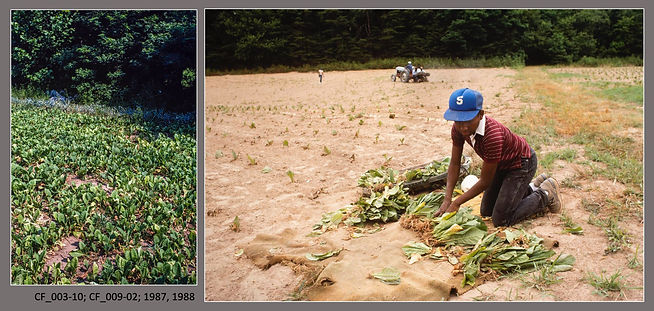
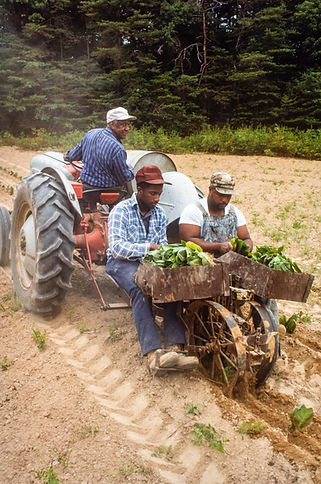
The June 1988 crew includes Woodrow Wallace driving the tractor while William Edward "Bucky" Weems and Sam Wallace ride the transplanter. Bucky is Woodrow's grandson; Sam is Woodrow's son.
Below: Photo from May 1989, shows Woodrow turning the tractor and transplanter at the end of a row.

The transplanter features a plow-like component that cuts a furrow in the ground. Woodrow called it a shoe; another term is furrow opener. When turning the tractor and planter at the end of a row, the transplanter was raised, revealing the shoe, the horizontal bottom section of the apparatus below the two seated men. When the planter was lowered, the shoe plowed a furrow where the plants are dropped. To moisten the soil, a hose carried water from the tank on the side of tractor to the shoe. Meanwhile, as the transplanter moved forward, two metal wheels in a V configuration at the back of the implement pushed soil together to close the furrow over the seedling's roots. Specification sheets from transplanter manufacturers call these press wheels, packer wheels, or packing wheels.
Bucky and Sam's seats flanked the device that carried out the transplanter's main function. Sprocket wheels powered a chain drive fitted with several plant holders. Woodrow's team called the plant holders fingers.
The tractor and transplanter never stopped their forward motion. This meant that Bucky and Sam's task--pulling individual seedlings out of the plant boxes and taking turns placing them in one of the fingers--required fast, well-coordinated movement.
The chain drive brought each finger down to the shoe where seedling was released into the furrow, roots down. As the plant was positioned, a hose applied a stream of water from the water tank.
Bucky Weems and Sam Wallace on the transplanter, with the fingers and drive chain between them. June 1988, CF_009-10.

End of the work session, June 1988.
Left: Sam Wallace washes up.
Right: The transplant work crew:
Woodrow Wallace,
grandson Johnny Weems,
grandson Bucky Weems,
grandnephew Derrick Parker, and
son Sam Wallace.


After the transplanter's run, there were dead or undersized plants in the rows. There were also gaps that some farmers called missing hills, harking back to the older method for planting by hand, one seedling to a "hill." To remedy this, Woodrow brought a half- or quarter-bushel basket with fresh seedlings to fill gaps or replace poor-quality plants. He used a small mason's trowel and had a jug to water them after sticking them in the ground.
In a conversation in 1989, when the transplanting had been done by a different crew than in 1988, Woodrow explained that part of the problem reflected the inexperience of some of the workers the day before. But, he said, there had also been problems with the transplanter and the work had been interrupted for repairs. For example, the all-important shoe had to be replaced at a cost of $58. In addition, he had to replace the drive chain that carries the fingers. Usually, Woodrow said, only chain links needed be replaced but this time they replaced the whole chain. "I've spent over $100 fixing my planter so far this year," WW said. But "it's good for twenty years, now. It's good now,” he chuckled.
I expressed surprise that parts were still made. Of course they are, Woodrow said. "Just get them from a Ford dealer, I go to Dorsey Gray." Woodrow had bought the transplanter about 30 years earlier from the Dorsey Gray Ford dealership for $300 or $350 dollars. Not only are the parts still made, but one can still buy the machines; Woodrow guessed the price would be around $1,000. [Endnote 2]
Woodrow Wallace filling the gaps left by the transplanter and crew. June 1989, CF_027-04.
Cultivating, fertilizing, and weeding (high summer)

Left: Cultivating rig on Woodrow's Farmall Cub tractor, with blades beneath and behind the chassis. Middle: Tobacco rows after cultivation. Right: Field and tractor after cultivation. June 1987.
Before the plants grow too tall to pass under the tractor, the soil is tilled (again) and some weeds are removed using cultivator blades fitted to the tractor. Pairs of blades are attached to fittings at the back and under the central section of the tractor. The blades have an arrowhead shape sometimes called a duck foot.
As cultivation took place, fertilizer was applied from the open plastic container fastened to the side of the tractor's fuel tank, dispensed thru a length of flexible PVC pipe. Woodrow mixed a tobacco fertilizer (4-8-12), and Bulldog Soda (16-0-0). On this 1989 occasion, Woodrow said he had bought 800 pounds of fertilizer from his supplier in Charlotte Hall but the year's full treatment would require 1,500 pounds. On another occasion, Woodrow estimated that his full-season requirement would cost about $300.
Woodrow mused about rain and its impact on fertilization. Too much rain just after the fertilizer is applied can wash it away. "It's not the soil that grows the tobacco," he said, "it's the fertilizer." In 1989, Woodrow said, he applied twice as much fertilizer as the previous year but the crop was still smaller than in 1988. He reminisced about his father's time, when they would apply fertilizer by hand, throwing it up against the plants in the rows. And they would plow some into the ground before planting. "But it didn't rain then the way it does now," he said. Woodrow and his father used horses to pull the plow and to pull the four-wheel wagons used to haul the tobacco to the barn. Some in the neighborhood used oxen and a two-wheeled ox cart, or a mule, but the Wallaces stuck with horses.
Later in the season, the plants are too tall to cultivate with the tractor and the work proceeds with hoes, by hand.
Left: Woodrow Wallace shows an example of the grassy weeds that have been removed.
Right: Woodrow, grandnephew Derrick Parker, and grandson Johnny Weems cultivate the crop.
Both photographs, August 1988.

Toward the end of the growing season, tobacco plants sprout flower buds. John C. Prouty, a farmer with an operation near Huntingtown, said that when the plant starts flowering. "you’ve got to go out there and break all the flowers." Called topping, many farmers walk the rows and use their thumbnails for this chore. “What [the plant] is trying to do," said S.L. Brady, a farmer who lives near Chaneyville, "is produce seed, but we’re not into seed production." [Endnote 3]
When Woodrow tops his plants, he does not use his thumbnail but usually breaks off the flowers and the upper segment of the plant using his whole hand. However, when Paula Johnson made these photographs in August 1988, she reported that Woodrow used a small crescent-shaped knife.

Woodrow Wallace topping his plants a week or two before harvest. Photographs by Paula J. Johnson, August 1988.
This webpage describes the first phases of the crop cycle at Woodrow Wallace’s tobacco operation. A second web page describes the later phases of the crop cycle.
Endnotes
-
This text benefited from information provided by The Money Crop: Calvert County After the Tobacco Buyout (2005) by Anne Sundermann. This book included selections from oral history interviews collected by Michael Kline and Carrie Nobel Kline. The book was published by the Maryland Historical Trust Press and the Calvert County Historic District Commission. Additional information was provided by Michael Phipps.
-
Transplanters are used for crops in addition to tobacco, e.g., sweet potatoes. Search engine results for transplanter will bring up several examples, including the Holland Transplanter, manufactured in Zeeland, Michigan.
-
The Money Crop, op. cit., p. 31.