
I. What's in a Name?
Over the years, the place name Governors Run has referred to a small creek (the run), a place where land and water transportation meet, a site for small businesses and commercial fishing operations and, in recent times, a community with a strong recreational profile. [Endnote 1]
The first occurrence of the place name that we have found is in a 1781 newspaper advertisement. Easom Edmonds sought the owner of a boat that washed up at Governor's Run.

Figure 1. Governors Run on a 1902 map, with overlays and some labels added in 2025.
-
Yellow shading, creek's main stream
-
Green shading, tributaries.
-
Red dashed line, steamboat wharf.
-
Label Governor Run, location of community businesses.
The line with crossing marks at the lower left documents the planned route for the Baltimore and Drum Point Railroad, never constructed. Map title: Calvert County Showing the Topography and Election Districts, Baltimore, Maryland Geological Survey, 1902. University of Alabama Map Library online.

Figure 2. Annapolis Gazette, 4 October 1781.
II. Transportation at Governors Run, 1700s to 1871: Before the Steamboats
From the eighteenth century forward, goods arrived at or departed from the landing via sailing craft. These vessels anchored in deeper water offshore and small craft transported material across the shallows, a method that continued even after the steamboat wharf had been built in 1871. Here's a description from 1923: While the bay shore of Calvert offers no harbor for small craft there is a wide curve in the shoreline sweeping westward and off Governor’s Run Wharf schooners anchor in the bay and load wood and other material to be freighted elsewhere. [Endnote 2]
Figure 3. Detail of an 1824 map. Color shading added in 2025 to highlight two roads to the landing then called Fraser's at the mouth of Governors Run creek.
Christ Church is identified at the far left.
Map title: Part of Patuxent River, Maryland, U.S. National Archives Record Group 77: Records of the Office of the Chief of Engineers; Series: Civil Works Map File; File Unit: Maryland, the District of Columbia, and the Potomac River, https://catalog.archives.gov/id/502286369,
consulted 4 September 2025.

Figure 3 features a detail of an 1824 map that omits the creek but shows two roads that farmers used to carry products to the landing and to bring home supplies. The owner of the land was identified in a deed as Charles M. Frazier and the place name (alternate spelling) is Frasers Landing. [Endnote 3]

Figure 4. Scenes from Virginia, not unlike those of Calvert County: rolling a tobacco hogshead to the waterfront and a small craft carrying eight hogsheads to a larger vessel for long-distance transport. (Hogsheads are casks used to transport tobacco to market.)
Illustrations by W. Newman, from William Tatham, An Historical and Practical Essay on the Culture and Commerce of Tobacco, London, 1800, p. 55.
In Chesapeake Bay Schooners, Quentin Snediker and Ann Jensen describe how freight vessels evolved from the fast Baltimore clippers employed by privateers in the Revolution and War of 1812. "From the 1840s on," Snediker and Jensen conclude, "the two-masted centerboard freight vessel that emerged was known simply as the Chesapeake Bay Schooner." [Endnote 4]
Figure 5.
Left: Drawing of a two-masted schooner as reproduced in Quentin Snediker and Ann Jensen's Chesapeake Bay Schooners (1992).
Right: Freight schooner on the Chesapeake with a load of lumber on deck, date and
exact location unknown, courtesy
Calvert Marine Museum (P-09956).

The shallows and deeper water at Governors Run are marked on the 1862 chart in figure 6. On this map, which postdates Frazier's sale of the land to George Washington Dorsey, the landing carries the creek name and the number of roads connecting it to nearby farms has risen from two to three. (For more information about George Dorsey (1818-1901), see George W. & Hannah Brooke Dorsey: Landowners, Farm Family, & Physician.)

Figure 6. Detail of an 1862 map that includes three roads to the maritime landing Governor's Run, at the southeast corner of an extensive farm owned by George W. Dorsey.
Coast Chart No. 33, Chesapeake Bay from Choptank River to Potomac River, Survey of the Coast of the United States.
Water depths in feet in the dotted area and in fathoms offshore; colored shading and label added for this webpage.
Library of Congress copy of this chart,
https://www.loc.gov/resource/g3842c.cw003350c/, consulted 4 September 2025.
III. Transportation at Governors Run, 1871-1925: The Steamboat Era
III A. Background and the Founding of the Governor's Run Wharf Company
In the mid-19th century, steamboats emerged as competitors to sailing vessels, with an increased impact after the Civil War: "Fewer and fewer new schooner hulls were being built . . . . By 1890, no more than eight hundred schooners worked the Bay, where once they numbered in the thousands." [Endnote 5]
Steamboat companies operated the vessels and managed facilities in Baltimore, the nerve center for Maryland's Chesapeake fleet, and they owned some wharves. Many other wharves, however, including the ones at Governors Run and Dares Wharf (today's Dares Beach), were small independent businesses run by local citizens. Wharves received fees from the steamboat companies for access to the wharf and its customers. Wharf companies also received payments from shippers for use of its facilities. Shareholders were motivated by the revenue paid in dividends and by knowing that a nearby wharf would boost their neighborhood's prosperity. Some shareholders were farmers whose income would benefit from improved transportation.
Calvert County land records include the Articles of Incorporation for the Governor’s Run Wharf Company. [Endnote 6] The original document had been signed December 16, 1870, with capital stock at $25,000. The five incorporators of the company were George W. Dorsey, William P. Dorsey, Octavius C. Bowen, John Parran, and Henry Williams. The Dorsey brothers were farmers; for more information, see George W. & Hannah Brooke Dorsey: Landowners, Farm Family, & Physician. Octavius C. Bowen's father, Octavius W. Bowen, owned the farm just north of George Dorsey. Henry Williams was a Prince Frederick attorney and a son-in-law of Mason Locke Weems of the Weems Steamboat Company. He represented the company's interests in the wharf.
III B. New Steamboat Landing and Scheduled Service
The first bayside wharf in Calvert County was located at Plum Point, 8 miles north of Governors Run, listed as a stop on the Weems Line Patuxent River Route by April 1856. [Endnote 7]
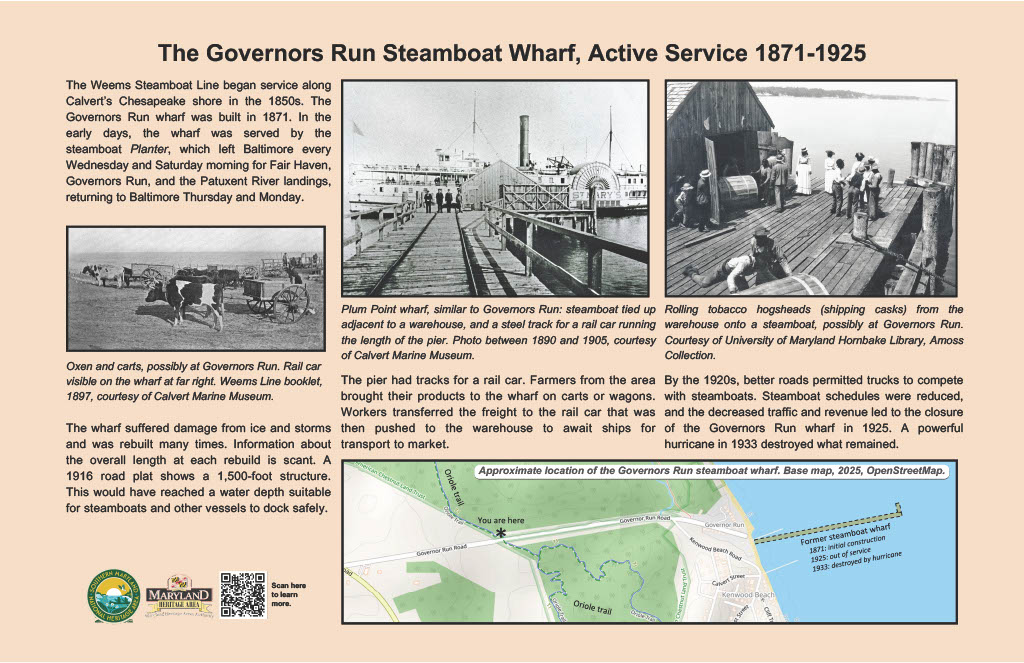
The Governor’s Run Wharf Company wasted no time building Calvert's second bayside wharf. The results are referenced in the Weems Line announcement of the 1871 autumn schedule for the steamboat Planter. The vessel leaves Baltimore "every Wednesday and Saturday morning at 6:30 o'clock, for Fair Haven [Anne Arundel County], Plum Point, Governor's Run, and Patuxent River . . . . Returning, leaves Benedict [Charles County, on the Patuxent] every Thursday and Monday morning at 6 o'clock for Baltimore . . . ." [Endnote 8]
The length of the wharf varied over time: a 1916 road plat indicates a 1,500-foot length for the structure, reaching waters with a depth of 20 feet, appropriate for steamboats that drew from about 8 to 15 feet. [Endnote 9] The 1902 election district map (Figure 1) shows that the wharf had a pier head where steamboats tied up and featured a small warehouse and livestock pen. The waiting room for passengers was onshore.

Figure 7. St. Mary's Beacon,
14 September 1871.
The Weems steamboat line lists Governor's Run as a regular call for the steamboat Planter, traveling from Baltimore to the Patuxent River and return.

Figure 8. The PCHT project has not found a picture of the Governors Run steamboat wharf with a vessel in place. This photograph of the very similar Plum Point wharf was made between 1890 and 1905, when the Weems Line steamboat St. Mary's was in service.
Governors Run also had a long wharf on the Bay, a pier head with a warehouse where the steamboat tied up, and a steel track for a rail car running the length of the pier's trestle.
Calvert Marine Museum, P-00551. Retouched to remove spots for this presentation.
Tobacco was shipped by steamboat to what was called the hogshead market in Baltimore. (Hogsheads are shipping casks.) As we report in the section titled The End of the Wharf as a Business below, steamboat service at Governors Run stopped in 1925 but at other wharves, a few farmers continued to ship hogsheads to Baltimore after 1939, when the looseleaf auction market got started in Hughesville, Maryland, and in a few other towns.
During a 1994 reunion of former Governors Run cottage-owners and renters, Bill Loveless, who spent summers there in the 1920s and early 1930s, said he recalled seeing hogsheads of tobacco hauled to the pier by oxcart, ready to be loaded onto steamboats.
Figure 9. Men rolling tobacco hogsheads onto a steamboat from the warehouse on the pier head. This daytime photograph predates 1908, when a schedule change brought the steamboats to bayside wharves only at night. The location is not identified but the topography in the background suggests that this could be the Governors Run wharf. (University of Maryland Hornbake Library, Amoss Collection.)

Figure 10 portrays oxcarts of the type that Loveless recalled. The items on the rail car may include tobacco hogsheads and/or containers for other farm goods. The scene makes a good fit for another description shared at the 1994 Governors Run reunion:
The pier had tracks with a metal container which went to the end. Farmers from St. Leonard used to bring their produce by wagons through what is now Kenwood to this pier. The produce was placed in the cart and taken to the end of the pier where ships would stop and take it to market. [Endnote 11]
Figure 10. Oxcarts at a site that we infer to be Governors Run Wharf. Note the rail car loaded with freight on the wharf end, right background. From Summer Homes and Historical Points Along the Routes of The Weems Steamboat Company, Williams & Wilkins Company Press, Baltimore, 1897, p. 40; Calvert Marine Museum, CMM MS 037, Box 1 Folder 1.

III C. Beyond Scheduled Service: Excursion Voyages
Steamboat lines provided vessels for fund-raising excursion trips in addition to scheduled service, often for events sponsored by local churches. In July 1895, one such excursion loaded passengers at Governors Run and the two other bayside wharves for a day trip to the Bay Ridge amusement park near Annapolis, active from about 1885 to 1904.
The managers of last Tuesday's excursion from Governor's Run, Plum Point and Fair Haven to Bay Ridge, gotten up for the benefit of Smithville M. E. Church, should be, and doubtless are, highly gratified at the success of the affair. All three of the stopping points contributed largely in making up the seven hundred or eight hundred persons that crowded the saloons and decks of the handsome steamer St. Mary's. The excursionists were allowed several hours at Bay Ridge, and right merrily did they enjoy in that time the many attractions of the popular western shore resort. The "Ferris wheel," the "merry-go round" and the "razzle dazzle" were the principal agencies that drew the nickels while the young and old were in the "whirl." [Endnote 12]
An 1886 excursion benefited a church near Parkers Creek with an African American congregation, later named Brown's Methodist Episcopal Church (after a 1968 denominational merger, Brown's United Methodist Church). The trip was a fund-raiser for a new church building.
Colored Excursion to Baltimore. The steamer Wenonah carried nearly six hundred colored excursionists from Governor's Run, Plum Point and Fair Haven to Baltimore on Friday night last. The boat started from Governor's Run at 10 P.M., calling at the above landings, and reached Baltimore early Saturday morning. The excursionists spent the day in the city and returned home Saturday night. Good order prevailed on the trip, and about one hundred and fifty dollars, over and above expenses, were realized by the managers, which will be applied to building a new church at Parker's Creek. Many of the excursionists had never made a trip to the Monumental City before and hence were very shy about venturing too far from the vicinity of Pier 8, Light Street Wharf, where the Wenonah landed her passengers. [Endnote 13]
III D. Wharf Maintenance: A Constant Challenge
The wharf at Governors Run was in an exposed position, vulnerable to natural forces. Damage to the wharf structure from storm driven winds, waves, and ice were reported regularly in the local newspapers. Ongoing repairs of the wharf were needed to ensure it remained a reliable shipping point. As early as 1874, marine contractor Nathaniel Clow completed a wharf that may have been a replacement for the 1871 structure. An October 1878 hurricane washed away about half of the wharf’s trestle (the main part of the wharf, sometimes called a bridge, between shore and pier head) and it was repaired the following May.
A news item from February 1886 describes damage cause by freezing winter weather:
A part of the wharf (about 75 feet) at Governor's Run was carried away by the ice in January. The wharf is again surrounded by ice and if it breaks up with a heavy wind, the entire wharf will probably he swept away. [Endnote 14]
In 1888, the company hired Clow to replace the aging wharf structure. The following year, an April nor'easter damaged its warehouse. In 1893, a late season hurricane swept away about 500 feet of its trestle. Drifting ice seriously damaged the structure in 1904 and 1912. In June 1919, the pierhead and warehouse burned, but were repaired that December. The following February, drifting ice carried away 300-400 feet of its bridge. Maintenance, repair, and rebuilding the wharf were conducted as ongoing activities to keep it in operation and the structure may have sustained instances of damage that went unreported in local newspapers. [Endnote 15]
III E. Businesses at Governors Run and the Growth of Recreation
The first businesses in Governors Run bore a relationship to shipping and the role of the location for local agriculture. For example, in June 1875, the Baltimore Sun included an advertisement for a new storehouse and dwelling, placed by the physician and farmer George W. Dorsey (1818-1901), owner of the land where the wharf had been built. [Endnote 16] The Governors Run Post Office was established in 1878 and received its mail via Weems steamers. George W. Dorsey's son, William A. Dorsey (1852-1931), served as postmaster from 1887 to 1893, and his wife Mary held the job from 1894 to 1898.
Due to its proximity to the steamboat landing, the Governors Run area attracted commercial activity. In 1886, William A. Peterson operated the store at Governors Run and was engaged, with Joseph P. Sollers, in commercial fishing, marketing a variety of fish caught with their haul seine. "Whenever the weather will permit," the Calvert Gazette reported, "their seine will be hauled every morning, and persons coming or sending for fish will always find a supply on hand in the afternoon . . . . very fine taylors [bluefish], rock, trout and crocus [croaker]." [Endnote 17]
A November 1886 news item reported "Mr. William Bafford has opened an oyster house at Governors Run and is doing a thriving business. The bivalves obtained from the bay are particularly delicious this fall." [Endnote 18] This was probably a seafood processing operation, preparing the catch for shipment. A few years later, Perry S. Ross had several dredge boats at work in the vicinity of Governors Run and was shipping two grades of barreled oysters, "selects and cullings" to Philadelphia in 1890, where they were declared to be "the best on the Philadelphia market." [Endnote 19]
Pound net fishermen also operated in waters off Governors Run. In April 1889, Joseph P. Sollers was catching "a plentiful supply of fish" from his nets at Governors Run. [Endnote 20] Edward Humphreys made an exceptional catch in his pound net in 1892: a seven-foot sturgeon. [Endnote 21]

As early as 1889, advertisements in the Baltimore Sun indicate the value of the Governors Run location for seasonal recreation. Mrs. W.A. (Mary) Dorsey's ad in figure 11 does not mention steamboats for travel from Baltimore, a fact that probably went without saying. But there is no doubt that convenient travel strengthened the appeal of this location.
Left: Figure 11. Classified advertisement, Baltimore Sun, 28 June 1889
In 1897, the Weems Line published a promotional booklet that echoed this idea, carrying a blurb about Mary Dorsey's boarding house as well as one operated by her neighbor Mrs. J.S. Talbott. In between is a description of Mrs. D.B. Gott's boarding house at Dare's Wharf (today's Dares Beach), where a pier had been constructed in 1890. The headline Along the Patuxent refers to the steamboat's Patuxent route: southbound along the bay shore to Drum Point, then north up the Patuxent River.
Figure 12. Boardinghouse descriptions in
Summer Homes and Historical Points Along the Routes of The Weems Steamboat Company,
Williams & Wilkins Company Press,
Baltimore: 1897: 55, CMM MS 037, Box 1 Folder 1.

Booster-minded newspaper accounts between 1889 and 1904 highlighted social events that drew people to Governors Run for reasons unconnected to steamboat travel. Several have tie-ins to the W.A. Dorsey household, whose boarding house evolved into the Cliffs Hotel as the 20th century proceeded.
-
August 1889: about 30 "young ladies and gentlemen" from Calvert County enjoyed a picnic and boat rides before going to the Grange Hall [on Broomes Island Road] to dance. "The most interesting feature of the evening was a car ride on the wharf in which all took part." We infer that the "car ride" was aboard the wharf’s freight rail car. [Endnote 22]
-
August 1900: masquerade ball held at Governors Run. [Endnote 23]
-
July 1902: dance at the home of Mr. and Mrs. William A. Dorsey, 9:00 p.m. to 3:00 a.m., music provided by a pianist from Baltimore. The lawn was decorated with Japanese lanterns, and the dance was held in the Dorsey’s parlor and long rear porch. [Endnote 24]
-
August 1903: jousting tournament featuring seven knights at Governors Run, followed by a "delightful dance" at the home of Mr. and Mrs. William A. Dorsey. [Endnote 25]
-
September 1904: jousting tournament and ball for the benefit of Christ Church. Eighteen knights entered the contest and prizes were awarded. A band from Baltimore played at both the tournament and the evening dance, held in the warehouse on the wharf "where a floor had been especially constructed for the occasion, and the place tastefully decorated and illuminated." [Endnote 26]
The wharf was also used for recreational fishing and crabbing.
-
August 1886: "The steamboat wharf at Governor's Run affords an opportunity for the enjoyment of fine sport at this time. The fishing and crabbing there are both excellent, and on any good day hundreds of corks may be seen bobbing up serenely in the hands of as many nimrods of the Chesapeake, from the young and festive 'kid' to some who have long since turned the three-score-and-ten point. Crocus are caught in great numbers, although rock, green fish (or taylor), brim and eel are by no means scarce. One day last week Mr. William A. Bafford caught two fine sheepshead near the pier, the first, it is said, ever caught at Governor’s Run." [Endnote 27]
III F. The End of the Wharf as a Business, 1925
The two decades following World War I saw improvements to Calvert County's land transportation routes, and shipping and travel by steamboat became less vital to the local economy. By 1924, limited steamboat service and decreased revenue caused the Governor's Run Wharf Company to announce its closing. After another disappointing season, the company was dissolved and its wharf property was sold in 1925 to the adjacent landowner, William A. Dorsey. At that time, the wharf was described as "in bad condition." Without a company to meet the expense of maintaining the wharf, it soon fell into disrepair and ceased being used. [Endnote 28]
IV. Governors Run Continues: A Brief Introduction
IV. A The Cliffs Hotel
The Governors Run cottage community continued and grew as the steamboat era came to an end. William A. Dorsey died in 1931 and there was some back and forth among his heirs about the property but, over time, his son George W. Dorsey (1887-1962), grandson of George W. Dorsey (1818-1901), took control and acquired the land. A glimpse of George W. Dorsey's management of the Cliffs Hotel during and after World War II is provided by the clipping that follows. Meanwhile, the year 1926 saw the launch of Kenwood Beach, a cottage community just to the south.


Figure 13. The Cliffs Hotel at the end of Governors Run Road, seen from the fishing pier, 1955. (Photo from the Gscheidle family, from a digital collection assembled by Ken Marton.)
Figure 14 . George W. Dorsey at Governors Run, 1950s. (Photo from Don Parks, from a digital collection assembled by Ken Marton.)
Figure 15. Excerpts from a promotional article about the Cliffs Hotel at Governors Run, Calvert Independent, 7 June 1945, p.1
IV.B Beachfront cottages and the hurricane of 1933
Shortly after his father's death, George W. Dorsey built nine rental cottages on the edge of the beach, six or seven of which stood a short distance north of the hotel, as pictured in figure 16. When Calvert County was struck by the powerful hurricane of August 1933, Dorsey's cottages were destroyed.
At Governor's Run on the bay a group of nine summer cottages, owned by George W. Dorsey, of Prince Frederick, and rented by residents of Washington, was demolished and swept away by the force of the wind and waves. The majority of these cottages were very attractively furnished, and when the houses went the contents were also lost, for when the occupants returned to Washington on Wednesday morning, inconvenienced by the rising tide, but not realizing the situation, they failed to remove their belongings. At Governor's Run a large number of pleasure boats were swept further down the bay and dashed to pieces on the beach at Briscoe's Landing. The total property damage at Governor's Run will reach into some thousands of dollars. [Endnote 29]

Figure 16.
Top: beachfront cottages at Governors Run in the early 1930s; composite photograph from Calvert Marine Museum P-10607 and P-10601, original photographs loaned by Bill Loveless.
Bottom: cottages at Governors Run damaged by hurricane, August 1933. Erickson family photographs from a digital collection assembled by Ken Marton.
From the 1930s to the 1950s, Weldon and Lula Parks ran a successful fishing-party boat and skiff-rental operation, as well as serving as keepers of a general store.
Meanwhile, in the 1960s, the Cliffs Hotel was sold to and updated by the Cammack family, then destroyed by fire in the 1980s.
Figure 17.
Top: catch from a 1934 fishing party outing, captain and guide Weldon Parks at right; Parks' business card; three fishing party boats tied up at Governors Run, probably in the late 1930s: Alva (Captain Parks), Moonlight (Captain Wolf), Kingfish (Captain Murphy).
Bottom: Weldon and Lula Parks in their store at Governors Run; exterior of store, 1950s. Photographs from Don Parks and the Gscheidle family from a digital collection assembled by Ken Marton.

The 1933 hurricane washed away anything that remained of the steamboat wharf. That was not, however, the end of piers at the community. Beginning in the late 1930s, both Governors Run and Kenwood Beach built a succession of fishing piers--also subject to storm and ice damage--and the latest iterations, private and for community members only--still stand today.
IV.C Revisiting the name
In March 1944, a chatty column in the Calvert Journal cited George W. Dorsey “for answering our request of last week in this column for information as to how Governor’s Run got its name.”
This is the interesting way Mr. Dorsey tells it: “It seems the First Governor of Maryland had established a beach-head about this point, and had wandered some distance up the trail, probably inspecting this part of his domain, or looking for a mint patch when he was approached by an attendant who said softly, ‘Don’t look now, your Excellency, but I think we are being followed.’ On assurance that Indians were near at hand, the Honorable Gent, it’s said, made a very hasty and successful embarkation to a waiting ship. The speed made, it is said, was noteworthy, hence the name ‘Governor’s Run.’ This is the story that was told me.” [Endnote 30]
The next week’s paper quoted another (unnamed) source with an alternate legend. But the columnist declared that he preferred Dorsey’s “more picturesque version.”
V. Postscript: ACLT Acquisition of Land Adjacent to Governors Run and Kenwood Beach
The cottage communities of Governors Run and Kenwood Beach occupy waterfront land at the eastern end of larger tracts. For the most part, the western segments of those tracts consist of hilly woodland, some of which had once been farmed. And at the far western ends of both properties, strips had been sold to the Baltimore Gas and Electric company for the power lines that run north from the Calvert Cliffs Nuclear Power Plant.
Regarding Governors Run, as described in part IV above, George W. Dorsey acquired the larger tract after his father's death in 1931. In 1960, two years before his death, Dorsey sold the property to buyers who defaulted on the mortgage, resulting in a 1963 sale to the Cammack family. In 1981, the Cammacks sold the land to a group of citizens, led by Gregory and Alicia Yowell and including Randi and Peter Vogt, leading founders of the ACLT six years later. The 1981 sale subdivided the land, defining the cottage community area and establishing a 79-acre western tract. This tract was purchased by the ACLT in 2021. [Endnote 31]
ACLT had purchased the 91-acre tract west of Kenwood Beach in April 1991. This land was separated from the rest of ACLT's holdings until the Governors Run property was added in 2021, establishing a continuum of protected and publicly accessible property. In January 2024, ACLT opened the new Oriole hiking trail that crosses both properties.
Acknowledgements and More Information
Significant portions of this webpage, especially the information about the steamboat wharf, represent the research and writing of Robert J. Hurry, the now-retired archivist at the Calvert Marine Museum in Solomons, Maryland.
-
Hurry's research report The Steamboat Wharf at Governors Run, Maryland, 1871-1925 has been abridged for this webpage.
This webpage also carries information from two other Robert J. Hurry reports that provide additional research findings on this topic:
The PCHT website also includes a related webpage and research report written by Robert J. Hurry:
-
Webpage: Steamboat Wharf at Dare's, 1885-1922
-
Research report: The Steamboat Wharf at Dare's, 1885-1922
The PCHT project gratefully acknowledges Hurry's contributions and for his permission to share these documents. Other segments of this page were researched and written by Carl Fleischhauer.
Endnotes
-
Where's the apostrophe in Governors Run? If we quote a work that uses a possessive apostrophe, we include it, and if we quote a source that omits the s, we omit it too. But when the PCHT project is the author, we follow the Principles, Policies, and Procedures of the U.S. Board on Geographic Names: "Apostrophes suggesting possession or association are discouraged within the body of a proper geographic name (Henrys Fork: not Henry’s Fork)." See the document linked from this webpage: https://www.usgs.gov/us-board-on-geographic-names/domestic-names, consulted 31 August 2025.
-
Swepson Earle, The Chesapeake Bay Country, Baltimore: Thompson-Ellis Co., 1923, p. 171.
-
The term landing is defined in the dictionary of the International Association of Marine Aids to Navigation and Lighthouse Authorities (IALA): "Any area, structure or part of a structure designated for the transfer of personnel or materials between a vessel and the shore or structure." (https://www.iala.int/wiki/dictionary/index.php/Landing, consulted 7 September 2025) In the Chesapeake, landing may name a site with or without a wharf.
-
Snediker, Quentin, and Ann Jensen, Chesapeake Bay Schooners, Centreville MD: Tidewater Publishers, 1992, p. 59.
-
Snediker and Jensen, Chesapeake Bay Schooners, op. cit, p. 62.
-
Calvert County Circuit Court, Articles of Incorporation, liber SS1, folios 0341-0342.
-
"Classified," Baltimore Sun, 04/29/1856: 2.
-
St. Mary's Beacon, 14 September 1871.
-
MdHR T-1211, Box 8, 1916 Survey Record.
-
Betsy and Don Kehne, "Bay Summers Cast Long Memories," New Bay Times, 7 Sept 1994, pp. 12-13.
-
Kehne and Kehne, op. cit.
-
Calvert Gazette, 27 July 1895
-
Calvert Gazette, 8 October 1886. The second part of this Calvert Gazette account, copied from a Baltimore Sun news story, does not add substantive information and it includes bigoted comments that trade on racial stereotypes. We have omitted it.
-
Calvert Gazette, 13 February 1886.
-
"Wharf Destroyed by Fire," Calvert Gazette, 06/21/1919: 1; "Local Brevities," Calvert Gazette, 12/06/1919: 1.
-
Baltimore Sun, 15 June 1875 and 16 September 1875.
-
"Where to Get Fish," Calvert Gazette, 08/28/1886: 3.
-
"Oyster House," Calvert Gazette, 11/27/1886: 3.
-
"Best on the Market," Calvert Gazette, 03/29/1890: 3.
-
"Fresh Fish" Calvert Gazette, 04/13/1889: 3.
-
"Local Brevities," Calvert Gazette, 10/15/1892: 3.
-
"Picnic," Calvert Gazette, 08/17/1889: 3.
-
"On The Chesapeake: A Mask Ball and Other Gayeties at Governor’s Run," Baltimore Sun, 08/07/1900: 8.
-
"Dance at Governor’s Run," Calvert Gazette, 07/19/1902: 3.
-
"Tournament at Governor’s Run," Calvert Gazette, 08/08/1903: 3.
-
"Tournament at Governor’s Run," Calvert Journal, 09/03/1904: 3; "Tournament and Ball," Calvert Journal, 09/10/1904: 3.
-
"Fine Sport," Calvert Gazette, 08/28/1886: 3.
-
The final actions dissolving the company were made in Equity Court. Exhibit Number 3 in the Equity Case Number 729 listed among the assets of the company “One Wharf in bad condition extending from Governor’s Run, Calvert County, Maryland, into the Chesapeake Bay and one waiting room at the shore end of said Wharf.” An advertisement for the November 17, 1925, public sale of the wharf property was published in local newspapers. (“Public Sale of Wharf Property,” Calvert Gazette, 10/31/1925: 1; 11/07/1925: 1).
-
"Storm Damages," Calvert Gazette, 26 August 1933.
-
Calvert Journal, 11 March 1944.
-
Relevant land records include: 1893, George W. Dorsey to William A. Dorsey, TBT 2/119; 1948, heirs of George W. Dorsey transfer property to George W. Dorsey, AWR 15/533; 1960, George W. Dorsey sells to Arthur E. and Mary G Brooks, JLB 31/125; 1963, Brooks foreclosed, atty Harkness sells to Cloverdale Corp. (Cammack family), JLB 61/634; 1980, Cloverdale sells 4.5 acres to BGE for power line right of way, ABE 266/672; 1981, Cloverdale sells to Yowell et al (Governors Run Development Corporation [GRDC]), ABE 279/08 and ABE 279/14; 2021, GRDC sells to ACLT, KPS-5959-503.