
George W. and
Hannah Brooke Dorsey:
Landowners, Farm Family,
& Physician
On this page ...
Tap to view trail sign
Introduction
George Washington Dorsey (1818-1901) was a physician and farmer who owned several properties in central Calvert County, including his home farm on a stream called Governors Run in Port Republic, Maryland, just south of today’s Scientists’ Cliffs community.
George W. Dorsey was married twice. His first wife was Martha Coberth (1826-1840), who was 14 years old when they married and died within a year; she is buried in the Coberth family cemetery in St. Leonard, Maryland. (Endnote 1) Dorsey and his second wife, Sarah Hannah Brooke Dorsey (1827-1912), usually called Hannah, lived in the house that is still standing on their former farm, on a privately owned segment not accessible to the public.
Hannah Dorsey was descended from the prominent seventeenth-century settler Robert Brooke. George and Hannah Dorsey’s great-grandson Thomas “Tommy” Turner (1902-2002, also a physician) reminisced about these family connections in his autobiography.
Turner writes, "Calvert was organized as a county in 1654 with Robert Brooke as 'Commander'. . . . My paternal great-grandmother, Hannah Brooke Dorsey, lived near the cliffs of Calvert, and was a descendant of Robert Brooke. A little couplet was written about her and handed down in the family: 'Doctor Dorsey was the smartest fisherman e're baited a hook, he got in the Royal Family by marrying Hannah Brooke!" (Endnote 2)

Hannah Brooke Dorsey, c. 1870. Photograph from A Few Steps Backward, a 1997 memoir by Dr. Thomas B. Turner (1902-2002), former owner of the Holly Hill farm.
Hannah’s sister Rebecca and Rebecca’s husband James A. Chesley lived on the next farm to the north from about the 1830s to the 1860s. Meanwhile, in 1881, Hannah and another sister, Anne Harriet Brooke Broome, sponsored a pair of stained glass windows in Christ Church (Episcopal), Port Republic, Maryland, dedicated to their parents and “brothers & sisters gone before.”

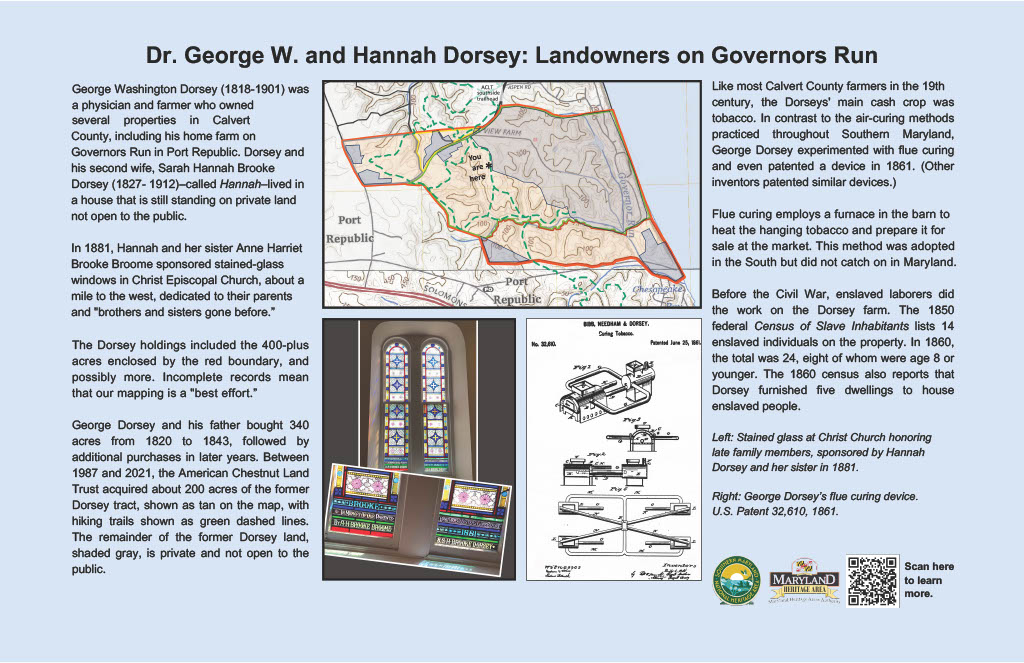
Brooke family commemorative window at Christ Church (Episcopal), Port Republic, Maryland, provided in 1881 by the sisters Anne Harriet Brooke Broome and Sarah Hannah Brooke Dorsey.
George W. Dorsey wanted to be sure that Hannah was cared for after his death. Their two-story house figures in an 1896 codicil to George W. Dorsey’s will, registered in 1901.

It is my will and desire that my wife S.H. Dorsey shall hold and possess during her natural life, the front part of the residence now occupied by us, and also the yard and both front and back of said building, and the garden also and the privilege of graising [sic] and keeping on the farm (given to my son W.A. Dorsey) a horse and cow and provender for the same in winter and room in the carriage house for carriage and the farm to furnish her with firewood. At the death of my said wife S.H. Dorsey the entire house goes to my son W.A. Dorsey the owner of the farm. (Register of wills identifier: VCC 1/301, 1901)
Great-grandson Tommy Turner recalled visiting that house as a boy, when his widowed great-grandmother was still alive and in the care of “a colored woman who had been born a slave.” (Endnote 3)
About the land
In 1820, James Dorsey (ca. 1776-1833) bought the core segment of this Dorsey property, deeded as 262 acres. (Endnote 4) At James Dorsey’s death, this tract passed to his son, George W. Dorsey. In 1843, George W. Dorsey bought an adjacent 82 acres from Charles M. Frazier (SS 01/70), for a total of 344 acres. The 1860 Agricultural Census cited in the section About the Farm, below, reports a total of 382 acres, “close enough” given the vagaries of many early- and mid-19th century surveys.

Headstone for a Dorsey grave in the family graveyard on the former Dorsey farm, Port Republic, Maryland. Wayne Neeld’s 1976-1977 documentation for the Maryland Inventory of Historic Properties (MIHP) CT-167 report identifies this as the grave of James B. Dorsey (1776-1833). (Endnote 5)
Later records indicate that the family–mainly George W. Dorsey, his brother, William P. Dorsey (1826-1881), and George’s son, William A. Dorsey (1852-1931)–acquired additional tracts of land, including nearby tracts not described on this webpage. A total of 450 acres is reported in a 1939 deed that post-dates the deaths of the three men and documents the sale of an equity share in the land by one set of heirs to another (AAH 40/473). Our research, however, has not turned up land records that account for this one-hundred-acre increase between the 1850s and 1939. (Endnote 6)
Map of the property

1860s to the 1930s, Dorsey property then. As noted in the text, we do not have firm data for some of these boundaries and this map should be understood as a best effort. Roads and topography from 2024.

Today: ACLT land (tan) open to the public and closed private land (gray shading). Portions of the former Dorsey farm and developed subdivisions are not open to the public. Visitors are asked to follow the marked hiking trails shown on ACLT trail maps and represented here as green dashed lines. The * asterisk and "you are here" mark the location of the ACLT heritage hiking-trail sign.
The Parkers Creek Heritage Trail (PCHT) team has not found definitive information about the extent and boundaries of the land formerly owned by George W. Dorsey and other members of this branch of the family. Our mapping should be understood as provisional.
Tract C. We believe that most of this tract consists of James Dorsey’s 1820 purchase from Thomas Jenkins of Indiana, who had acquired the land from James Mackall Wilson in 1802. It is described in the 1802 deed as containing 262 acres and “on the Northernmost side of the whole tract of land [colonial-era land patent] called Lower Bennett.” [endnote 7] There may have been post-1820 additions and/or boundary adjustments. This tract is in the Governors Run watershed. Our mapping of tract C represents about 250 acres. About 150 acres are owned today by ACLT.
Tract D. 82-acre tract that George W. Dorsey bought from Charles M. Frazier in 1843. Much of the southern boundary follows the routing of the former road to the Governors Run landing, one of at least two roads that connected local farmers to steamboats and other freight vessels. This winding road was replaced at some point after World War II by the relatively straight road that serves travelers today. This tract is in the Governors Run watershed. Its eastern “toe” was subdivided beginning in the 1950s and is now the Governors Run community. The remainder of the tract now belongs to the ACLT. More information about the disposition of this tract is provided in the final section of this page, Dorsey land transfers and sales from 1860 to 1960.
Tract A. In 1943, this 40-acre tract was sold by Dorsey descendants to the African American farm couple Clarence and Henrietta Commodore. Most or all this tract is in the Parkers Creek watershed. The PCHT team has not identified how or when this land was acquired by the Dorseys. In 2013, more than 30 acres of this tract were purchased by ACLT from descendants of the Commodores.
Tract B. Today, this tract consists of at least three subdivided parcels. Most or all this tract is in the Parkers Creek watershed. The PCHT team has not traced the ownership history and our mapping of this tract as once belonging to the Dorseys is speculative.
About the farm and the Agricultural Census
The archaeologist James G. Gibb used the George W. Dorsey farm as an illustrative example in an article about the federal agricultural census, data that had been collected and archived for 1850, 1860, 1870, and 1880. (Endnote 8) Gibb’s snapshot of the Dorsey farm in 1850 also included data from the separate federal census of Slave Inhabitants, described in the following section. Here’s what Gibb wrote:
George W. and Sarah H. Dorsey owned a farm in the Port Republic area of the First [Election] District in 1850. A physician by training, George and his wife managed 275 acres of improved farmland [and more than 100 acres of unimproved land] which they planted with the help of 14 slaves (at least half of whom were children). Their farm was valued at $9,000, employed $300 worth of machinery and equipment, and produced 14,000 pounds of tobacco, 40 bushels of wheat, 900 bushels of maize (Indian corn) and no oats. Their wheat and oat crops are inconsiderable as both fall below the averages of 86 and 25 bushels, respectively, for the district. On the other hand, their farm is considerably larger and more valuable than most of the neighboring farms, and their investment in machinery is accordingly greater. Both their tobacco and maize crops fall outside of, and on the high side of the 67 percent range. They are large-scale, well-to-do planters, focusing on tobacco (a cash crop) and maize (an important food item, particularly given the number of enslaved farm hands), while virtually ignoring other grains. (Endnote 9)
Reproduced below is part of the Agricultural Schedule (census) ledger page for 1860 that includes information about the Dorsey farm at that date. As the caption indicates, the most striking change from 1850 is the increase in tobacco and wheat production.

In 1860, the 382-acre farm (250 acres improved, i.e., tilled for crops or pasture; 132 acres unimproved) was valued at $9,550 [1850: $9,000], and employed $400 worth of machinery and equipment [1850: $300]. The farm produced tobacco, 43,000 pounds [1850: 14,000]; wheat, 500 bushels [1850: 40]; maize (Indian corn), 800 bushels [1850: 900]; and oats, 200 bushels [1850: 0].
Enslaved laborers on the farm and the federal census of Slave Inhabitants
In 1850 and 1860, the main U.S. decennial census pages are labeled Free Inhabitants, and the enumerations included Free Blacks (as they were called at the time). Meanwhile, enslaved individuals were recorded separately in what is often called the slave schedule, where the printed pages are labeled Slave Inhabitants. The slave schedules are organized by the names of owners and (for the most part) the names of enslaved persons are not provided. However, the listings provide the enslaved individual’s age, gender, and color (B for Black and M for mulatto).
James Gibb’s description of the Dorsey farm in 1850, quoted above, reports the presence of “14 slaves (at least half of whom were children).” The illustration below provides the information for the 24 individuals counted in 1860, and reports that Dorsey provided 5 dwellings for them. Here’s a summary by age range:
-
60-80, 2 men
-
30-40, 3 men, 2 women
-
12-24, 5 men, 4 women
-
8 and younger, 4 male, 4 female

The 1860 Census of Slave Inhabitants enumeration for George W. Dorsey runs across two pages in the census ledger book. The count of 5 dwellings for the enslaved is in column 9.
Experiment with flue-curing tobacco
The historic preservation specialist Wayne Neeld described one of Dorsey’s tobacco barns in his 1977 report for the Maryland Inventory of Historic Properties, slightly edited for this webpage. This barn still stands on private land, not accessible to the public:
-
There are two modern tobacco barns and, on the crest of a hill, a third tobacco house which is of great historic interest. With its sheds, this barn measures 36×68 feet overall. The frame of the main block, however, is a standard 24×40-foot (ten tobacco-hanging “rooms”) post-and-beam structure. The members of this frame are hewn and joined together via mortise-and-tenon joints secured by trunnels. This frame has been placed upon 3-foot brick piers and the floor has been dug out into a pit so that there is a distance of 4 feet between the sills and the earth below. The present owner says that his father told him that this was done in order to accommodate a flue-curing apparatus.
-
There is other evidence that the main block was an airtight barn. On all but the north wall, pieces of siding remain which reveal that the building was covered with heavy vertical siding. Each board was approximately 1 inch thick, 9 inches wide, and 13 feet long (eaves-sill). The boards are rabbeted on the edges for half-lapping (vertical shiplap). Such siding is obviously designed to prevent any flow of air. however, this special siding does not appear to be weathered. (Endnote 10)
Neeld concludes the barn was constructed, at the latest, during the final third of the 19th century, a period when a few Southern Maryland farmers experimented with flue-curing as an alternate to the traditional air curing favored in the region. Flue-curing barns apply warm air to the tobacco from a furnace and a system of flues not unlike those used to force hot air through a home.
George W. Dorsey figures in this story in an important way. When the archaeologists James Gibb, Patricia McGuire, and Julia King studied Calvert’s experiment with flue curing, they found an 1861 patent for a flue curing system submitted by two men from Baltimore and George W. Dorsey of Port Republic (U.S. Patent 32,610).

Detail from the drawing for the tobacco furnace and flue system patented by Bently Bibb, George F. Needham, and George W. Dorsey, June 25, 1861. Figures 1, 2, and 3 show the basic one-furnace system for barns up to twenty-four by forty-eight feet. Item A is the furnace, under hot-air jacket B. Smoke and other products of combustion flow through pipe D to drum E, and thence exit the barn via chimney F. The pipes labeled G and H move hot air through or into the barn, thus affecting the cure of the tobacco. Water evaporating from the pans labeled U provides appropriate levels of humidity for the curing. From the documentation for U.S. Patent 32,610.
Julia King wrote that by 1867, Dorsey was promoting his device, writing in the Maryland Farmer that he had been using the furnace “with entire satisfaction, increasing greatly the value of the tobacco cured by it.” (Endnote 11) The furnace and flues were manufactured in Baltimore and advertised for sale at prices ranging from $110 to $150, a very high price for Southern Maryland tobacco farmers at the time. King writes that “even the wealthiest farmers would have been hard pressed to afford the flue.” The use of the device was short-lived, and it is last mentioned in the Maryland Farmer in 1873.
Dorsey land transfers and sales from 1860 to 1960
This section presents a simplified description of key land sales by the Dorseys. The earliest examples for which we found records date from the mid- and late-19th century and include complex interfamilial allocations in 1860 (WD & DK 2/339) and 1883 (SS 1/72).
Leaping ahead to 1939, decades after the death of George W. Dorsey (1818-1901), we found records for several transactions, including the trio described here. The first took place in April 1939, when George W. Dorsey’s remaining heirs sorted out their mutual equity interests in the land near Governors Run (AAH 40/473). In November 1939, what we call tract C on our map was subdivided and two large sections were sold. Flippo and Annie Gravatt purchased about 150 acres (AAH 43/389). Of this land, the 35-acre bayside section became part of the Scientists’ Cliffs community. Most of the remainder, about 110 acres, was kept in an undeveloped state and, after the Gravatts died, was acquired by the ACLT in 1987. This segment is now traversed by the ACLT’s East Loop hiking trail. Meanwhile, in the third transaction, also in November 1939, Philip P. and Mattie Weems purchased about 100 acres (AAH 43/391). In recent years, this privately owned parcel was called Eastview Farm.
In 1943, the Dorsey heirs sold tract A to Clarence and Henrietta Commodore. Recent surveys indicate that this parcel comprised more than 40 acres. In 2013, the ACLT purchased about 36 acres from the Commodore heirs, and soon blazed a hiking trail named for the trust’s past president, Karen Edgecombe.
Meanwhile, the segment of land that we identify as tract D--which includes today's Governors Run cottage community--was held by members of the Dorsey family until 1960. Ownership passed back and forth in the family: here’s an abbreviated account. In 1893, George W. Dorsey (1818-1901) sold the land to his son William A. Dorsey (TBT 02/119). William A. Dorsey died in 1931. For a period, the land was held by a group of family members, and in 1948, it was transferred to George W. Dorsey (1887-1962), William A. Dorsey’s son.
These ownership changes took place in parallel with changes in the role of the Governors Run community. Before the era of summer cottages, Governors Run was an important stop for the steamboats that transported vegetables and tobacco to the markets in Baltimore. Steamboat service at Governors Run began in the mid-19th century and stopped in 1925, during a decade that saw improved trucks and better roads provide farmers with a viable alternate mode of transport. By the 1930s, businesses in Governors Run mostly catered to recreation-minded customers drawn to the location by its rural setting, beach, and sport fishing.

George W. Dorsey at Governors Run in the 1950s. Photograph from Don Parks, part of a digital collection assembled by Ken Marton.
With an eye on these new customers--even before he acquired full ownership of the land in 1948--George W. Dorsey continued and expanded upon his father's enterprises. These included the boarding house cum Cliffs Hotel, a swimming beach, and the construction of rental cottages. An account of this period and George W. Dorsey's role is included in our history of Governors Run.

The Cliffs Hotel at Governors Run. Left: In the early 1930s, porch not screened and no sign on the southeast-facing gable. Right: In the 1950s. Left photograph from the Erickson family, right photograph from Don Parks, both are part of a digital collection assembled by Ken Marton.
Then in 1960, as he turned 73, George Dorsey sold the property to Arthur and Mary Brooks. But the Brookses were unable to make their mortgage payments. Foreclosure took place in 1963, and the Cloverdale Corporation (owned by the Cammack family) bought the property at auction. During this period, the bayside section was subdivided and started to give shape to the Governors Run cottage community, while the undeveloped land to the west was held by a succession of owners. (More on this in our history of Governors Run. The relevant 1960 land record is JLB 31/125; subsequent records include JLB 61/634, ABE 266/672, and ABE 279/08.) In 1980, 4.5 acres of the western segment were sold to Baltimore Gas and Electric as part of the right of way for the power lines running north from the nuclear power plant. In 2021, ACLT bought the remaining 78 acres of the western segment (KPS 5959/503). This tract is now transected by the ACLT’s Oriole hiking trail.
Endnotes
-
Find-a-Grave entry for Martha Coberth Dorsey, https://www.findagrave.com/memorial/110304925/martha-dorsey, consulted 30 March 2025.
-
Turner, Thomas B., Part of Medicine, Part of Me: Musings of a Johns Hopkins Dean, [Johns Hopkins Medical School], 1981, p. 3.
-
ACLT interview, September 22, 1996.
-
This information is from secondary sources, including Maryland Old Graveyards, by Jerry and Mildred O’Brien and Merle L. Gibbons, 1986.
-
Maryland Inventory of Historic Properties (MIHP) CT-167, pdf-page 15, https://apps.mht.maryland.gov/mihp/MIHPCard.aspx?MIHPNo=CT-167, consulted 12 March 2025. At least one family genealogist has identified this headstone as that of James Dorsey’s son Robert L. Dorsey (George W. Dorsey’s brother) and suggests that a footstone at the site may mark James B. Dorsey’s grave. (Vivian Gray, Early Tombstones of Calvert County, 1960, pp. 17-18, cited in the Find-a-Grave.com entry for James B. Dorsey; https://www.findagrave.com/memorial/96565097/james-b-dorsey, consulted 12 March 2025.)
-
The increase in acreage may be explained by an entry in Ailene Hutchins’s 1982 book Calvert County, Maryland: Early Land Records that describes William P. Dorsey’s 1866 purchase of land from Octavius Bowen, although no acreage is specified (p. 132). By that year, Bowen had moved to land just north of the Dorseys, and the sale of a portion of this newly acquired property would be a good fit. The deed survey Hutchins quotes, however, suggests that William P. Dorsey may have purchased part of Bowen’s prior farm, about a mile distant.
-
From a transcription by Edna Lines, for the Daughters of the American Revolution, in the collections of the First Christian Church, Baltimore, Maryland, accessed via FamilySearch.org.
-
At this writing, the Agricultural Schedule census is only available on microfilm. For more information, see the National Archives web page: https://www.archives.gov/research/census/nonpopulation.
-
Gibb, James G. “Using Calvert County’s Agricultural Censuses:1850-1880,” Calvert Historian, Winter 1990, pp. 9 ff.
-
Maryland Inventory of Historic Properties (MIHP) CT-167, op. cit., pp. 2-3 (pdf-pages 9-10).
-
King, Julia A. “Tobacco, Innovation, and Economic Persistence in Nineteenth-Century Southern Maryland,” Agricultural History, vol. 71, no. 2, 1997, pp. 207–36. JSTOR, http://www.jstor.org/stable/3744247. Accessed 2 Apr. 2025.