
The Yoe Family and Farm: A Brief History
Calvert County, Maryland, 1659 to the Present

On this page . . .
Dogwood and grain sorghum, October 2021. Photo by Beth Yoe Fiddler.
This webpage was researched and written by Beth Yoe Fiddler, a ninth-generation descendant of Stephen Yoe, who arrived in Maryland in 1659. Drafted with the help of Beth's sisters and brothers, this is a revised version of a blog presented on the American Chestnut Land Trust's website in June 2023, shortly after the sale of the Yoe farm to the ACLT. Beth said that although the family's sale had a tinge of melancholy, they were "happy to know that the fields and woods they knew and loved will remain undeveloped forever."
About the Yoe family
Generation 1
After two decades of genealogical research, the current generation of Calvert County Yoes believe that Stephen Yoe (alternate spellings include Yowe, Yeo, and Yow) was the first in their family to arrive in Maryland, landing in 1659. [endnote 1] The documentation in Gust Skordas' The Early Settlers of Maryland states that Stephen Yowe was 21 years old upon his arrival, indicating a birth year of 1636. He seems likely to have been the Stephen Yeo, a son of Charles Yeo and Elizabeth Herringham Yeo, who was christened January 1, 1637, at St. Dunstan Church, Stepney, London. Charles was a sea captain, and St. Dunstan's many links with sailors and shipping account for the church being known as the Church of the High Seas. [endnote 2]
It was challenging to connect Stephen Yoe with generation 2 in the lineage associated with the Yoe farm. A clue turned up in the 1757 sale of a property named Ludford's Hope in southern Prince George's County, originally granted to Arthur Ludford and Stephen Yeo in 1665. [endnote 3] The documentation for the 1757 sale featured a second Stephen Yoe, who inherited his share of the property from his grandfather and namesake, the co-patentee in 1665. It also names John Yoe (born 1666-1668, died 1733) as the son of Stephen (generation 1) and the father of the second Stephen.
This finding helps us interpret the 1666 will in which Stephen Yow (generation 1) bequeaths to his wife Ann "all my whole estate," and to her children Henry and Dorothy--apparently from an earlier marriage--"one cow" each. [endnote 4] Not mentioned in the will is Stephen and Ann's own child, the abovenamed John, almost certainly born shortly after the will had been written, i.e., 1666-1668, possibly after his father's death.
Meanwhile, Stephen Yoe's 1667 estate inventory included at least two items that were uncommon at the time and indicative of Yoe's relative wealth: "four table forks" and "one looking glasse," the latter listed in the following illustration.

Excerpts from the Prerogative Court (Testamentary Proceedings) Stephen Yeo, Book 2, pp.206-211, dated July 22, 1667 [MSA S529-7;01/12/02/27].
Top: "A True Inventory of the Estate of one Stephen Yeo, deceased, made this two and twentieth day of July, in the year of our Lord one thousand six hundred sixty seven."
Bottom: excerpt from the inventory, including "one looking glasse." All items are valued in pounds of tobacco, the primary currency at the time.
Generation 2
The real estate transaction for Ludford's Hope helped us identify John Yoe, born circa 1666-1668, died 1733, as generation 2 in our lineage. His children included the brothers Stephen, who figures in the sale of Ludford's Hope, and Robert, who represents our generation 3.
As a sidenote, there was a second John Yoe–born 1651, died 1686, and not related to Stephen–living in central Calvert County. This John Yoe (or Yeo) was a well-known cleric, almost certainly the first rector of Christ Church, then in Calverton on the Patuxent River, now located in Port Republic. The Rev. John Yoe, not yet married, moved away from Calvert County in 1677. [endnote 5]
Generation 3
Robert Yoe, date of birth unknown, died circa 1761. He was the brother of the Stephen Yoe who played a role in the Ludford's Hope land transaction described above.
Generation 4
John Yoe, born July 29, 1750, died circa 1813. Among John's six sons and three daughters by two wives was a son named Robert. This Robert Yoe observed the enslaved Frisby Harris "acting as an officer" when the British burned the Calvert County courthouse in 1814. Frisby Harris was enslaved to William Harris, who lived a short distance north of Parkers Creek, but at the time of this event, he had been hired out to Dr. John H. Beall, whose property stood at God's Graces Point on the Patuxent River (opposite today's Chalk Point Power Plant). Frisby Harris had escaped and joined the British fleet as it sailed up the Patuxent, en route to Washington, where the British burned the Capitol building and White House. [endnote 6]
Generation 5
James Yoe, born August 28, 1795, died after 1860. James was the brother of the Robert Yoe who witnessed the courthouse burning described in the preceding section. James Yoe and his wife Ann Williams represent generation 5 in our lineage.

Detail from the decennial census for 1860. The page heading was Free Inhabitants, to distinguish this listing of White and Black individuals from the separate enumeration often referred to as the Slave Schedule or the Slave Census. [endnote 7] Nelson Sanders is listed with a B, indicating that he was Black.
The 1860 census shows James Yoe, age 60, and John Williams Yoe, age 25, farming together in Port Republic. Also living on the property at the time was an African American named Nelson Sanders, a free man enumerated by the census as a carpenter. Sanders may have worked building either the "old barn" or the "old house" on the Yoe Farm, described in the later segment of this webpage devoted to the farm.
Generation 6
John Williams Yoe, born November 15, 1833, died January 26, 1901. He married Mahala Eugenia Holt (1857-1943) on January 21, 1879; she survived him.
Mahala Eugenia Holt Yoe, date unknown.

Generation 7
John Williams Yoe, born April 8, 1886, died June 5, 1964. John Williams Yoe and Elsie Mae Weems were married on January 20, 1909.

John Williams Yoe, date unknown.

Elsie Mae Weems Yoe at the front porch of the Yoe's "new house," photographed circa 1960.
Together, they had six children, identified in the following section. John Williams and Elsie Mae had been married for 55 years when John died. Elsie died December 31, 1978, at the age of 87. Both John and Elsie are buried at Christ Church, Port Republic MD. They are the grandparents fondly remembered in the statements that conclude this webpage.
Generation 8
John and Elsie's six children comprise generation 8.
First, Howard Philip Yoe was born in 1910. His first wife was Susanna Dixon Yoe. Susanna's daughters from a previous marriage, Mary Jane Warren McMenamy and Carolyn Warren Gafner, recalled many happy childhood visits to the Yoe Farm. Howard and Susanna's two children were H. Randolph Yoe, who died very young, and Pamela Yoe Hoffman, who also shared memories of visiting her Yoe grandparents on trips from Baltimore. Susanna died in 1955 and, some years later, Howard married Della Marie Yoe.
Second, Mary Madeline Yoe was born in 1912. Madeline married George Fink, and they lived in Baltimore. They had one daughter, Shirley, who died in 2011. Madeline and George welcomed their niece, Pamela Yoe Hoffman, into their home, as she was still a baby when her mother died.
Third, John Alvin Yoe, generally called Alvin, was born in 1914. Except for his World War II service in North Africa, Sicily and Italy, Alvin spent his entire life in Calvert County. In 1948, he married Mae Elizabeth "Betty" Gosnell (born 1921) and their five children are identified in the following section, devoted to generation 9. Betty died in 1985, Alvin in 1995.

John Alvin Yoe and Thomas Linwood Yoe, mid-1930s.

Elizabeth "Betty" Gosnell Yoe, ca. 1948.
Fourth, Betty Louise Yoe was born in 1916. She married Philip J. Trueschler, Jr. They lived in Baltimore and had no children.
Fifth, Thomas Linwood Yoe, generally called Linwood, was born in 1922. He married Grace Gibson. They lived in Huntingtown and had no children.
Sixth, Elsie Anne Yoe was born in 1929. The house on the Yoe Farm was her residence for most of her life. Anne died in 2025.

Elsie Anne Yoe, in about 1939.
Generation 9
Generation 9 is composed of the many children--by birth or via marriage--descended from the members of generation 8. Several from generation 9 contributed to the section titled Life on our Yoe Grandparents' Farm, below.
One generation 9 group with strong connections to the Yoe Farm consists of the five children of Alvin and Betty Yoe: Elizabeth (Beth) Degitz Yoe Fiddler, Mary Ruth Yoe, John Williams Yoe, Marjorie (Margie) Anne Yoe, and James Gosnell Yoe. Alvin and Betty lived just north of the Yoe farm, and for the five children, it was a short walk across "the flat" to their grandparents' home. Several others from generation 9 lived a bit further away but also enjoyed visits to the farm. Mary Jane Warren McMenamy, Carolyn Warren Gafner, and Pamela Yoe Hoffman contributed to the bundle of memories shared in the final section of this webpage.
About the farm


Old barn at the Yoe farm, now gone, sided with hand-riven clapboarding.
First photo includes John Williams Yoe (1886-1964, generation 7).
Photographs circa 1960.
Yoe Farm: First period of family ownership, 1860s to 1901
The Yoe farm lies on Calvert County's main ridge road (today's state highway 2-4) about three miles south of Prince Frederick. Determining a historical chain of title for property in Calvert County is complicated by two disastrous fires in 1882, destroying the courthouse in March, when some records were saved, and then destroying the temporary storage building in June. The information that remains is characterized by vague descriptions and fluctuating acreages. Meanwhile, research continues to determine with certainty which colonial-era land patent or patents underlie today's Yoe Farm. One segment is almost certainly part of a tract known as Horse Range, patented by James Ayling in 1723.
Members of the Yoe family may have acquired the farm at about the time of the Civil War. The 1860 census reports that the heads of the Yoe household in generations 5 (James Yoe; 1795-after 1860) and 6 (John Williams Yoe; 1833-1901) did not own real property at that time. The 1870 census, however, shows John Williams Yoe as a landowner, indicating that he acquired the Yoe farm between 1860 and 1870. (Note that in addition to generation 6, there are men named John Willams Yoe in generations 7 and 9.)
Extent of the property
Historical surveys of the farm during most of the years of Yoe ownership report an extent of 169 acres. This extent was reduced by 4 acres that John Williams Yoe (generation 7) sold to Alvin Yoe (generation 8) at the time of his marriage in 1948, property kept in the family until 1998. A survey from the early 2000s, shortly before ACLT's purchase of the farm, report an extent of 161 acres that, together with Alvin Yoe's former 4 acres, yields a total of 165 acres. This small discrepancy is not atypical for surveys separated by decades.

The Yoe farm. The base map carries information from 2024 and presents the tract boundaries as of the 2022 sale to ACLT, enclosing 161 acres. A tributary of Parkers Creek crosses the back section of the property. Two dwellings are described in later sections of this webpage: the "new house" (built 1918, red icon) and the "old house" (built in the mid-19th century, green icon).
Losing the land and regaining it, 1901-1914
By 1901, when John Williams Yoe (generation 6) died, he had lived on the Yoe Farm since 1860. He was survived by his widow, Mahala Eugenia Holt Yoe, and five children, including John Williams Yoe (generation 7, the authors' grandfather).
After the death of John Williams Yoe (6), there was a legal dispute between his siblings for ownership that lasted until February 22, 1913, at which time a decree of the Circuit Court for Calvert County vested title in J. Briscoe Bunting as trustee. On April 5, 1913, the trustee sold the farm to Joseph C. Webster pursuant to a further decree of the Circuit Court. In less than a year, however, John Williams Yoe (7) recovered the property, purchasing it from Webster on March 5, 1914.
The old house
In 1909, during the familial dispute, John Williams Yoe (7) married Elsie Mae Weems. The farm was still occupied by the family, however, and that is where John and Elsie began their married life. The first of their six children was born in the "old house," a handsome timber-framed building that still stands today, although in very deteriorated condition.

The timber-framed "old house" as it stands today, about 200 yards north of the "new house." Construction details support the mid-19th century date.

Stone fireplace at "the old house" that, like the house itself, is now deteriorated. Both photographs by Carl Fleischhauer, 2022.
The Bay Farm, 1911-1915
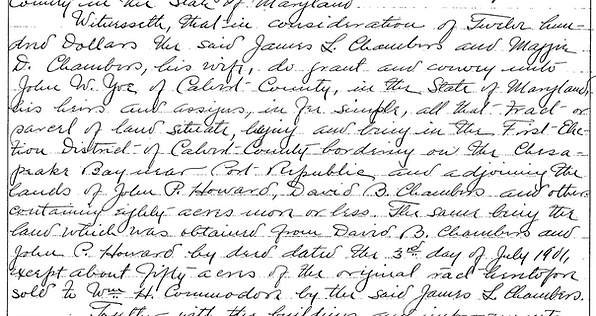
By 1911, in part to protect against the risk of loss of the farm, John Williams Yoe purchased 80 acres on the Chesapeake Bay, part of which is today's gate D neighborhood in Scientists' Cliffs. John and Elsie's second child was born in "the Bay house."
Segment of the 1911 deed for the Yoe's 80-acre Bay farm, which included land that was later part of the Gate D neighborhood of Scientists' Cliffs. John Williams Yoe, the grandson of the John Williams Yoe who bought this property, states that the Bay Farm was probably acquired "as a hedge that [his grandfather] would not gain full ownership of the 169-acre 'farm on the road.'"
Back to the Yoe farm, 1914-2022
As it happened, the bayfront hedge property was not needed. A year after John Williams Yoe reacquired the property in 1914, he sold the bayfront 80 acres. There is some uncertainty as to whether Alvin, John Williams and Elsie Yoe's third child, was born in the Bay house or the old house but their fourth child was born in 1916 the old house. The new house was built circa 1918, and John and Elsie's two youngest children were born there.
After John Williams Yoe (7) died in 1964, his heirs did not divide the farm, only selling shares among themselves. Thus, the Yoe Farm remained essentially as it had been until it was purchased by the American Chestnut Land Trust in 2022.

1938: land use at the Yoe farm as shown on a Soil Conservation Service aerial photograph, accessed via the Calvert County, Maryland, interactive GIS system, Historic Imagery Map. Property boundaries are approximate.

2023: land use at the Yoe farm as shown on an aerial photograph provided on the Calvert County, Maryland, interactive GIS system, Historic Imagery Map. Property boundaries from the 1920s and 1930s are approximate.
Tobacco: the cash crop until 1985
Like most Southern Maryland farms from the colonial period to the 1970s and 1980s, tobacco was the cash crop. The Yoe farm's peak production of tobacco occurred shortly before, during, and just after World War II. Tobacco was grown on ten or twelve acres, yielding a crop that often filled the family's four barns plus a fifth barn they rented just down the road.
John Williams Yoe, named for his grandfather, vividly recalls the story of his first tobacco crop:
When I turned six in 1961, Grandpop decided I should have a direct stake in that year's tobacco crop. A small field, no more than a quarter acre, was "Johnny's Field" that year. August rolled around and the harvest crew made their way to the fields adjacent to mine. Disappointed that no one was assigned to my field, I took matters into my own hands. Retrieving a small hand saw from the red F-250 pickup truck, I started sawing my crop down. This got a big laugh from everyone, as normally tobacco is chopped down [with a big knife]. Grandpop said kindly that my field was not quite ready for harvest, and I could put my saw away for the day. The next spring, my crop fetched $75 at the market, a small fortune to an almost seven-year-old.

Workhorses named King and Bill. This pair were the last to occupy the stable near the house. They worked in the fields for John Williams Yoe until about 1951, when he bought his first tractor, a McCormick Farmall Super A. The horses were retired and, as grandson John puts it, "lived a life of leisure" on the farm until they died in the 1960s.
In 2024, John Williams Yoe, my brother, and myself, Beth Yoe Fiddler, recalled harvest times from the 1960s and 1970s. Our father Alvin's main business was as a building contractor, but that work came to a halt when the tobacco was mature and ready to be cut. The work crew was a mix of family and neighbors, White and Black. Some came from other farms, trading workdays with us, while others earned a bit of cash as day laborers.
John: [August was] the start of the . . . tobacco harvest season . . . . So all of a sudden, whatever projects we had carpentry wise or home building wise or whatnot, they would go on hold for the month of August. . . . before my mom had to go back to [teach] school . . . we had the tobacco to harvest, and it would be always some number of whoever was available. The crew could vary in size from three or four to there would be 10 or 11 of us, I think, at peak. I started out . . . with the small task of just picking up plants and handing them to the men who were spearing them, putting them onto the tobacco sticks . . . .
John: And then you just remember at lunchtime, everybody would be called in. We didn't have room for everybody at the table. The table sat six and a half or whatever. Six and half was about the number, but we had big shade trees and so forth outside. So between my mom and Beth and Mary Ruth and so forth, a nice lunch would be served as typically corn on cob, sliced tomatoes, some meat of some sort, whether it's maybe a ham sandwich or whatnot, whatever you had.
Beth: The idea was you had to feed a bunch of hungry men as much as you could for the least amount of money as you could.
John: And fill up the water jug. Always remember to, I'm not sure where this came from, fill up the water jug, but be sure to put some lemon in it so you don't get a stomachache or whatnot out in the field. And then back we would go. But again, it was me, then later my brother would join in on the crew and my dad. And then basically the Parkers Creek community came [to help out] and said, "We've got to get this crop off the ground." And everybody just kind of understood that's what we do. [endnote 8]
Alvin Yoe decided to stop tobacco cultivation in 1985, the year his wife Betty died, and he reached the age of 71. The family let the land lie fallow for two years and then began leasing the fields to farmers who cultivated small grains, corn, and soybeans, crops now typical for farms in the region not yet subdivided for development.
Recollections of life on our grandparents' farm

The new Yoe farmhouse (built 1918). Photograph ca. 1960.
The following memories were written by the grandchildren of John Williams Yoe and Elsie Weems, Yoe. We loved our grandparents–and we cherish our memories of them, their home, and their farm. The oldest of us remember times before the current house had electricity, indoor, plumbing, or central heating. Some of us lived in Baltimore, and so coming to the country, for a visit was a great adventure.
-
Mary Jane McMenamy recalls that Grandmom would put wood in the big stove for cooking; it made the kitchen very cozy. Dinners included vegetables from her garden and biscuits made from scratch. The most fun was watching her chase the chicken that was to be our dinner.
-
Carolyn Gafner wrote that at night we would huddle by the wood stove in the kitchen. Our light was an oil lamp. There was an outhouse for use in the daytime; there were porcelain potties with lids for nighttime. Each bedroom also had large ceramic pitchers with matching large bowls, for washing up.
-
Mary Jane and Carolyn both remember that on Saturday evening, the bathtub was brought into the kitchen, water (drawn by bucket from the well in the side yard) was heated on the stove, and one by one each family member took a turn to bathe. The men filled a basin with warm water from the stove and shaved on the glassed-in back porch.
-
While Beth was too young to remember this event herself, she does remember being told, quite often, the story of her parents' first trip to Prince Frederick, about three weeks after she was born. It was a rainy, chilly April day, and Grandmom, who had been enlisted as an experienced babysitter, became concerned that tiny Beth, who weighed just over five pounds, would take a chill in the house. At that time, the kitchen stove was still a wood stove, and the oven door opened out into the kitchen. To keep Beth warm, Grandmom tucked her swaddled body into her roasting pan and set the pan on the oven door! Fortunately, it was not a Sunday, and so the roasting pan was not occupied by a chicken. Grandmom was occasionally heard to say, "None of MY babies was that small!"
Family in the yard, Howard Philip Yoe standing in foreground. The well that served the house for many years is in the background. Date unknown.

-
Every grandchild recalls that even after the house had indoor plumbing, Grandmom or Grandpop would draw water from the well and we would drink the icy cold water from a tin dipper—a refreshing treat on a hot summer evening. Those of us who lived next door and ran around mostly barefoot and bare legged all summer also recall the rivulets of cool water running down our legs, streaking our dust-covered shins.
-
Pam remembers that Grandmom would putter around the kitchen, singing "What a Friend We Have in Jesus." Pam continued, Grandmom always wore a plaid housedress, an apron, stockings rolled just above her knees and held in place with elastic garters, and black oxfords, from the popular Enna Jetticks brand of footwear. Sometimes she had a picture of her oldest, my father, pinned to her dress. It was the pin he had worn as an air raid warden during WW 2. One afternoon, she went out to the hen house and came out with a large hen under her arm and went into the kitchen. I shuddered in disbelief because I knew what was going to happen. Sure enough we had fried chicken for dinner that night.
-
There is no one who remembers leaving Grandmom's house hungry and those who enjoyed her Sunday or company dinners all praised her cooking. However, those of her grandchildren who lived next door appreciated her generous snack policy, whether it was a ham sandwich cut diagonally or across, to your preference, or an offering of candy from her pantry. Grandpop liked yellow cake with chocolate frosting, and it was kept in the refrigerator. That, too, was a treat.

Family in the kitchen of the Yoe farmhouse, circa 1952. Howard Philip Yoe is at the left and Elsie Mae Weems Yoe is at right.
-
Margie, too, recalls drinking hot Lipton tea and ginger snaps at the red-trimmed kitchen table. She remembers, too, singing familiar church hymns from memory with Grandmom, who would praise her singing ability.
-
Snacks were not limited to her grandchildren, however. Beth recalls a warm summer afternoon when Grandpop was working, hoeing tobacco, in a field far from the house. Grandmom gave her a lidded mason jar filled with water and lemon slices, and a small brown bag with gingersnaps, with instructions to take them to Grandpop. She was reminded not to eat any of the cookies on the way to the field as they were for her "Johnny" to "settle his stomach." When she arrived at the field, Grandpop opened the bag of gingersnaps and immediately handed her one, which she of course ate. When she got back to the house, Grandmom gave her gingersnaps, too, even though she explained that she had already had one.
Sisters Beth (now Fiddler) and Mary Ruth Yoe with puppies; farm outbuildings in background, 1960.

-
Beth also remembers that in the late afternoon, she would sit on the kitchen steps and hold a mirror for Grandmom, who "fixed myself up for Johnny" before Grandpop came home for supper. Grandmom changed her apron, and after a touch of Pond's Cold Cream, eyebrow pencil, rouge, and lipstick, and a fresh twist of her long hair into a bun, she looked pretty and happy.
-
After Grandpop's death in 1964, Grandmom enjoyed having one of her nearby grandchildren spend the night for company. John recounts: I remember her making sure I had a proper snack of Pepsi and fudge stripe cookies while doing homework, which she called lessons. Lessons completed, I would read every word of the Evening Sun sports section. On some winter nights, even with the house heated, the wind would rattle the windows and seemingly come right into the bedrooms. Grandmom always prepared a hot water bottle to keep at my feet on those coldest of nights.
Those of us grandchildren who lived nearby also are able to recall a few events on the farm which we have only shared with each other. Our parents never knew the particulars, and since the statute of limitations may not have run out on these misadventures, we will not share them here! They were, suffice it to say, great bonding experiences as we were always able to resolve the situations on our own!

Cars in the farmhouse driveway for a family gathering. Thomas Linwood Yoe is standing in front of a 1939 Chevrolet, with other pre-World War II vehicles in the background. The photograph may well be more recent than the vehicles: prewar automobiles continued to provide good service well after the end of the conflict and the cessation of wartime rationing.
-
Beth adds that while some memories are of specific events, there are some others that are snippets, consisting of moments of remembered light, or never to be forgotten smells. The smell of tobacco lingers in barns that have not held tobacco for years, or is infused in the antique, crooked tobacco stick that now serves only a decorative purpose. Shafts of light still fall, slanted, through the walls of the corn crib and the meat house. Larger rays of light create patterns on the hard-packed dirt floors of the barn. Fingers still feel the hard kernels of field corn on the cob, and the sound of the kernels falling as the corn was shelled into a metal pan, to feed the chickens. There is the feel of a scratchy wool cardigan sweater against the tender skin of a little girl sitting on her grandfather's lap. There is the feel of the velvet dust that rose between bare toes on the family's evening walks to the old barn, to close its doors, or inspect the fields.
-
Then there are the more recent memories. Mary Ruth shares: In the 1970s, I stood with Daddy at the edge of "the flat," the long, broad swathe of fields that lay between our house and that of our grandparents, stretching back to poplar, pine, and hickory woods. Our backs to Route 4, we watched my brothers plant row after row of tobacco in the early June evening. As shadows began the lengthen, Daddy turned to me and asked, "Do you know why I farm?" I could tell a rhetorical question when I heard one, so I waited. His answer was not what I expected: "I farm for the curve of the trees against the sky." His eyes shifted to the field, and his voice shifted gears, barking out an order to my brothers, "Get that tractor back in line."
These memories are preserved in the hearts of all the grandchildren who, whether visitors from the city or living right next door, were privileged to experience life on the farm. With the acquisition of the Yoe Farm by the American Chestnut Land Trust, we are delighted that "the curve of the trees against the sky" has been preserved for generations to come.
Looking north across a field at the Yoe farm, with the "old house" visible in the trees at right center.
Photograph 2022,
Carl Fleischhauer.

Postscript

June 17, 2023. Five members of Yoe generation 9 attended the event that celebrated the transfer of the Yoe farm to the American Chestnut Land Trust. This event also marked a new role for the Yoe's "new house," to provide housing for the ACLT's interns.
Left to right: James Gosnell Yoe, Elizabeth (Beth) Degitz Yoe Fiddler, Mary Ruth Yoe, Marjorie (Margie) Anne Yoe, and John Williams Yoe.
Endnotes
-
Skordas, Gust, The Early Settlers of Maryland (Baltimore: Genealogical Pub. Co., 1968), p. 524.
-
England Birth and Christenings, 1538-1975, from Family Search, Film No. 595497.
-
MSA patent records, L8/513 (microfilm SR7350).
-
Will dated April 4, 1666, probated July 16, 1667, WBV 1, page 286, online via MSA S538-1, https://guide.msa.maryland.gov/pages/series.aspx?ID=s538.
-
For those interested in the Rev. John Yoe, sources include an article in the August 22, 1890, issue of The Aegis & Intelligencer, Bel Air, Harford County, Maryland, that states, "[Ruthel Garrett's] widow married the Rev. John Yeo, a clergyman of the Church of England, and as far as now known positively, the first minister who preached the gospel of Christ in Baltimore county. The fact of marriage and relationship, is shown by a deed addressed to all Christian people, dated 29th December 1683, in which John Yeo conveyed to his son-in-law [stepson] Garrett Fitzgarrett [i.e., son of Garrett] a tract of 150 acres of land, called New Parke, adjoining said son-in-law's land, Carter's Rest, to go to his children, if he leaves any; if not, to go at his death, to his mother, Somelia Yeo, if she be then living, but if dead, to go to the heirs of the said John Yeo." This land is in today's Harford County, on Aberdeen Proving Ground. Another article, in the September 5, 1890, issue of The Aegis & Intelligencer, states "[Yoe] died in 1686, leaving three children, Joseph, of whom there is no further account; John, who was 'Debit Clerk of Baltimore county,' and a married daughter the wife of Garrett Fitz-Garrett." The article also indicates that John Yoe's wife was named Semelia [Somelia].
-
For more information, see Archives of Maryland (Biographical Series), "Frisby Harris (b. circa 1796 - d. ?)," MSA SC 5496-050643, shortened URL, https://bit.ly/42Blwyu (consulted April 18, 2026).
-
In 1850 and 1860, enslaved individuals were recorded separately in the federal census slave schedule, where the printed pages are labeled Slave Inhabitants. The slave schedule is organized by the names of owners and, for the most part, the names of enslaved persons are not provided.
-
Recorded interview with sister and brother Beth Yoe Fiddler and John Williams Yoe, 3 August 2024. ACLT Heritage Trail participants included Darlene Harrod, Kirsti Uunila, Carl Fleischhauer, Saroja Raman, and Shirley Knight.