
History of Holly Hill
Part 1: Dare Family, 1780s-1900
On this page . . .
Introduction: Two Families, Two Centuries (Plus)
Holly Hill was established by members of the Dare family during the 18th century and farmed by them during virtually all of the 19th century. Part 1 of the Holly Hill History (this webpage) presents the Parkers Creek Heritage project's findings about the Dare period. The Turner family acquired the farm at the beginning of the 20th century and owned it until the 2017 sale to the ACLT. Part 2 (separate webpage) presents information about the Turner period, 1901-2017.

Figure 1. The red boundary marks Holly Hill under ACLT ownership, 2021. Map produced by ACLT.
When the ACLT purchased Holly Hill from the Turner family in 2017, its extent was about 400 acres: 335 acres of woodland punctuated by ravines, 60 acres of cultivated farmland, and 5 acres with a house, yard, garden, barn, and lane. Various 19th- and 20th-century sources state Holly Hill's size in a range from 150 to 340 acres. In part, this variation reflects the levels of accuracy and precision offered by the historic land surveys consulted for this report. We believe that the variation also reflects decisions by the Dares and the Turners. Both families also owned adjacent properties and, when holdings were passed on the next generation it is likely that some lines of division were redrawn, shifting land from one family property to another.
I. 1780s: Dare Family Acquires and Consolidates Land
In the mid- to late-18th century, Holly Hill was one of three Dare family properties near Parkers Creek and the Chesapeake Bay. The first generations of the family in Maryland were descendants of James Dare, who arrived from England in 1670, [Endnote 1] and his descendants assembled extensive land holdings in the neighborhood. Tax records for this area identify property owners in the family as Nathaniel Dare (probably 1678-1742) and his wife Mary Clevely (1675-1748), and their sons Gideon Dare (1727-1781, called Gideon Dare I in this document) and [Thomas] Clevely Dare (1741-died after 1783, called Thomas Clevely Dare I in this document). The name Clevely is often written as Cleverly.
The records from this period are incomplete and our best guess is that the Dare family assembled Holly Hill from segments of the colonial patents (land grants) called Agreement, Darby, Neglect, Balles (aka Ball), Warrington, and a few others, for a total of 630 (one source) or 530 (second source) acres. Other nearby Dare properties were assembled in a similar manner from these and other colonial land patents. [Endnote 2]
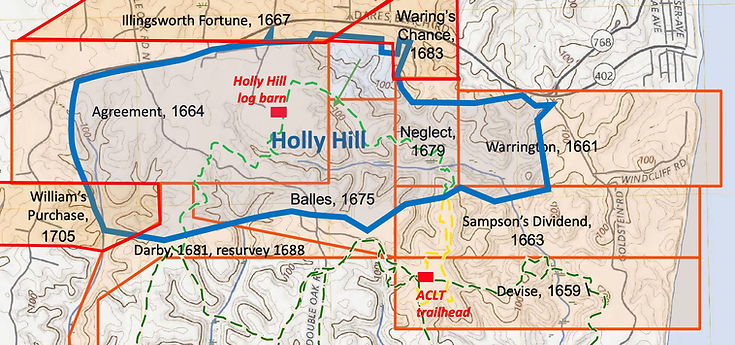
Figure 2. The blue line shows the approximate location of Holly Hill (2021 boundaries) relative to our best-effort delineation of colonial-era land patents.
Map research by Rachel Bissett, delineation by Exa Grubb and Carl Fleischhauer.
II. 1809-1820: Gideon Dare II, Three Sons, Three Grandsons
II.A Cast of characters, sources of information
Early 19th century land records bring us to the extended family of a subsequent Gideon Dare (before 1766-circa 1820, called Gideon Dare II in this document), probably the son of Thomas Clevely Dare I. Gideon Dare II was a Quaker and the father of ten children born from the 1770s to the 1790s, duly recorded in Quaker records. [Endnote 3] Three of Gideon's sons and three of his grandsons figure in the history of Holly Hill and adjoining land. [Endnote 4]
-
Sons:
-
Thomas Clevely Dare II (1779-ca 1838)
-
Henry Dare (1781-prob. 1833)
-
Richard Dare (1792-after 1833)
-
-
Grandsons, children of Thomas Clevely Dare II:
-
Richard S. Dare (1805-1868)
-
Thomas Clevely Dare III (1806/1809-1843)
-
John G. Dare (1823-1890)
-
Here's a recap for readers in need of a scorecard:

Figure 3. Dare family tree.
The author of this webpage added the Roman numerals to selected names in 2026 to make it easier to distinguish family members with identical names.
II.B 1820: Death of Gideon Dare II, bequest of Holly Hill and two other properties
Gideon Dare II's 1819 will, written one year before his death and summarized in the records of a Chancery Court case, includes bequests of land to three of his sons. [Endnote 5]
-
First, to his son Thomas C. Dare II, the "plantation whereon I now live," a reference to the Bayside Farm, lying to the east of Holly Hill. The Chancery Court record includes a deposition that states the extent as 175 acres. [Endnote 6]
-
Second, to his son Henry Dare "all the remainder of my land to him & his heirs forever," which we interpret to mean Holly Hill. The Chancery Court record includes a deposition that states the extent as 150 acres.
-
Third, to his son Gideon Dare (called Gideon Dare III in this document), another nearby property. This may be the land just north of Holly Hill, one of the three properties identified with the name Dare on the map in figure 5.

Figure 4. Three Dare households are shown on this map, surveyed in 1824 and published in 1857. We believe that the Dare household to the east is Bayside Farm, occupied by Gideon Dare II prior to his death in 1820. Meanwhile, the Dare household south of the main east-west road is Holly Hill, occupied by Henry Dare until at least 1825, when the property was sold due to unpaid debts. It is possible that the household north of the main road was Gideon Dare III's property. Meanwhile, the abbreviation M.H. marks the site of a Quaker Meeting House, and the abbreviation W.H. marks the site of a warehouse at Allnut's Landing (sometimes spelled Allnutt's; later Dares Wharf and today the site of the Dares Beach community). Detail from U.S. Engineer Dept., Maj. J.J. Abert and Maj. J. Kearney, Map of the Patuxent & St. Mary's Rivers; survey 1824, pub 1857. The full map is linked from the Calvert County historic maps page.
III. 1822-1838: Loss And Recovery of Holly Hill, Court Case
1822-1825: Henry Dare failed to pay a debt, Holly Hill sold out of Dare family
Henry Dare failed to pay a debt to Joseph G. Waters and in 1822, following a writ of execution on a judgement against Dare, Holly Hill was seized and put up for sale by the sheriff. In 1825, the farm was purchased by Nathan Levering of Baltimore.
1832-1833: Holly Hill recovered by Thomas Clevely Dare, death of Henry Dare
In 1832, Nathan Levering sold the land to Thomas C. Dare II, Henry Dare's brother. Henry died the following year.
1838: Death of Thomas Clevely Dare, bequest of Holly Hill and one other property
Thomas Clevely Dare II died; his will included the following bequests:
- - Holly Hill to his son Richard S. Dare.
- - Bayside plantation to his son Thomas Clevely Dare (called in this document Thomas Clevely Dare III), "where on he now lives."
Thomas Clevely Dare II's will also instructs his widow Elizabeth and son Richard S. Dare to serve as guardians to his 15-year-old son John G. Dare. (Various records provide differing birthdates for John G. Dare. We use the date on his tombstone: 1823.)
SIDEBAR: Chancery Court case re: Dare family loss and recovery of Holly Hill
Catherine Dare was the widow of Henry Dare, who had owned Holly Hill until 1825. In a case that reached the Maryland Chancery Court in 1850, [Endnote 8] Catherine Dare sought to obtain the dower portion of the property from the then-owner, her nephew Richard S. Dare, who inherited the property from his father and Catherine's brother-in-law, Thomas Clevely Dare II in 1838.
In this period, a dower portion was generally understood as consisting of one-third the value of a deceased husband's estate. Upon the widow's death, this portion would typically revert to the deceased husband's heirs. The documents that comprise the written record for this case run from 1850 to 1854.

Figure 5. From the Chancery Court record: " . . . Your complainant further shows that her husband the said Henry Dare departed this life about the year 1833 by reason whereof she became entitled to dower in said land, that she has never made any conveyance, assignment, or other disposition of her said dower interest in said land, and she has frequently applied to the said Richard S. Dare to assign to and put her in possession of her dower interest aforesaid which he has always refused to do all which actings and doings are contrary to equity and [tend] to the manifest injury of your complainant . . . "
A court decision is not included in the case file, but our analysis of the record indicates that outcome was decided in favor of Richard S. Dare. We infer that the court held that Catherine Dare’s dower rights were extinguished when Henry Dare defaulted on his debt and Holly Hill was sold out of the family in 1825. Thus, Thomas C. Dare's 1832 repurchase seems to have been considered as a fresh acquisition.
IV. 1840-1860: Smaller Family, Households Include Free Blacks
IV.A Background
The decades from 1840 to 1860 were a time of consolidation for this branch of the Dare family. Our study of the census for that period, as well as the names and dates on gravestones, indicate that deaths family shrank the number of Dare households from three to two.
The censuses for 1840, 1850, and 1860 were the last before the Civil War. During this period, the households for this branch of the Dare family include 18 Free Blacks, the term of the era for African Americans who were not enslaved. In some cases, their occupations are provided: laborers and domestic servants. During this same period, only one enslaved person--a girl younger than ten--is listed. Additional information was provided by the Agricultural Schedule, a separate federal census often called the Agricultural Census. [Endnote 10]
IV.B 1840: Three households, including Holly Hill
Note: The 1840 census only identifies the heads of households by name. Other members of the household are categorized by gender and age-range and, for African Americans, as Free colored and Slave.
Household 1: Richard S. Dare; the chancery court record indicates that this was the household at Holly Hill. We interpret the census data as reporting the presence of Richard Dare's wife Priscilla Allnutt Dare (prob b 1809-d 1858). Sarah Dare, the couple's only child, was born in 1840 (not listed in the census) and died in 1842. [Endnote 11] The household also included four Free Blacks, two men and two women, and an under-ten-year-old enslaved girl.
This may have been the period when the log barn was built at Holly Hill; see the webpage Holly Hill Log Barn.
Household 2: Elizabeth Snowden Dare (1784/5-1859, widow of Thomas Clevely Dare II). We interpret the chancery court record and census data as indicating that this was the Bayside Farm, and that the household included Elizabeth's son John G. Dare and four Free Blacks, two men and two women.
Household 3: Thomas Clevely Dare III; location not identified. The census data reports that this household included two Free Blacks, one man and one woman.
IV.C 1850: Two households, including Holly Hill
Household 1: Richard S. Dare, whom we believe lived at Holly Hill, although the extent of 555 acres reported in the 1850 Agricultural Census suggests Dare's farm operation included additional land. [Endnote 12] The household includes Dare's wife Priscilla, who died in 1858. [Endnote 13] Although the census does not enumerate any Free Blacks in the household, there are adjacent listings for Free Black households, possibly tenant farmers.
Household 2: John G. Dare; presumably at the Bayside Farm. [Endnote 14] This household also included Dare's mother Elizabeth Dare, who would die in 1859. Although the census does not enumerate any Free Blacks in the household, there are adjacent listings for Free Black households, possibly tenant farmers.
IV.D 1860: Two households, including Holly Hill
Compared to the 1850 census, the most significant change in the two households in 1860 resulted from a pair of deaths. At Holly Hill, Richard's wife Priscilla died in 1858 and, at the Bayside Farm, Richard and John's mother, Elizabeth, died in 1859.
Meanwhile, Free Blacks, now identified by name, are enumerated in both households. Richard Dare's household at Holly Hill included Dennis Blake (laborer) and Horace Gross (no occupation listed), as well as a 7-year old White girl named Rachel Ramsey. John Dare's household at the Bayside Farm included Jacob Boots (laborer), Roaney Boots (washwoman), Eliza Boots (washwoman), [Julia?] Boots (no occupation), Tom Boots (no occupation), and Baby Boots (infant). Incidentally, the next household listed after John Dare on the census ledger is an eight-person Free Black family, headed by Samuel Boots (laborer).
We are unable to interpret the Dare entries in the 1860 Agricultural Census with confidence. Although Richard S. Dare and John G. Dare are listed separately, each listing features two farms at 337 and 175 acres. This may indicate that the brothers shared the management of Holly Hill and the Bayside Farm; the total acreage of 512 for the two properties is roughly consistent with earlier reports. Although the acreage is the same for both brothers, the production figures are not. The cash crop of tobacco appears in three of the four listings, with impressive yields of 14,000, 11,000 and 7,000 lbs. Other farm data also lists horses, oxen, milk cows, hogs, and sheep, and the sale of potatoes and butter.
In this decade, John Dare's name turns up in a Civil War military registration record although there is no indication that he was drafted. [Endnote 15]
V. 1870-1880: John G. Dare at Holly Hill, Black Farm and Domestic Workers
Richard S. Dare died in 1868. The 1870 Agricultural Census associates 285 acres with John G. Dare; we have not determined how to account for the reduction from the 1860 total of 512 acres. We speculate that the Bayside Farm and other land to the east was sold at some point prior to 1870, and that John Dare had moved to Holly Hill.
The census listing for John Dare's household includes eight African Americans. [Endnote 16] Six are listed as farm laborers: Samuel Boots, George Hicks, William Smith, George Boots, Jeremiah Boots. The list also includes Barbara Beckett, domestic servant, with her son William, age 6.
In 1880, John Dare's household included five African Americans: Wesley Whillington (probably Whittington, servant), Charles Freeland (servant), Barbara Flint (keeping house), W. Henry Flint (farmhand), and James Parish (servant).
Virginia E. "Jennie" Freeland (1832-1900), who joined John Dare as his life companion at some point in this general period, is enumerated as residing with her brother George Freeland, "two households over" in the 1870 and 1880 census listings.
VI. 1890-1901: Death of John Dare, Holly Hill Bequest to Virginia Freeland


Side-by-side grave markers for Virginia E. "Jennie" Freeland (1831-1900) and John G. Dare (1823-1890), at St. Paul's Episcopal Church extension cemetery, formerly a Freeland family cemetery. Both stones have fallen from their original upright positions. The closeup shows the inscription on John Dare's stone: We miss thee from our home dear friend, we miss three from thy place, A shadow o'er our life is cast, We miss the sunshine of thy face, We miss thy kind and willing hand, Thy fond and earnest care, Our home is dark without thee, We miss three everywhere.
John G. Dare died in 1890 and bequeathed Holly Hill to his life companion Jennie Freeland.
-
" … I give and devise unto the said Virginia E. Freeland the Farm or Plantation whereon I now reside containing Three hundred acres more or less, to her and her heirs and assigns in fee simple…." (Calvert County Wills VCC 1:110)
VII. Holly Hill history continues with the Turner family in part 2
In the latter years of Virginia "Jennie" Freeland's life (and probably even before John Dare's death), her niece Virginia "Jennie" Freeland Lyles (1878-1970) joined the household. Within a year of Jennie Freeland's death, Jennie Lyles married George Dorsey Turner (1868-1948), who bought Holly Hill for his new bride. A description of the Turner family years is presented in History of Holly Hill, Part 2: Turner Family, 1901-2017.
Endnotes
Acknowledgements: This page was drafted by Carl Fleischhauer in 2021 and extensively revised in 2026. It owes a great debt to research carried out by Leila Boyer in 2020 and 2021 on behalf of the Parkers Creek Heritage Trail project. Colonial land record research and mapping by Rachel Bissett; PCHT maps delineated by ACLT staff and Exa Grubb.
1. Charles Stein, A History of Calvert County, 1976, p. 253.
2. The tax records cited are from colonial Maryland in 1733 and the state of Maryland in 1782 and 1783. Not all 17th and 18th century properties are represented by extant surveys and the surveys in hand are inexact and subject to interpretation. We infer that Holly Hill was assembled from the land in the following colonial land grants: The Agreement, patented in 1664 by James Shacklady and Nicolas Hammond (Hamond); Darby, including a resurvey, patented in 1681 and 1688 by Francis Buxton; and from a trio of seemingly overlapping patents.
The earliest patent in the confusing set of overlapping grants was Ball (or Balles), awarded in 1675 to Nicholas Furnasse (or Furnas and other spellings). Either because Furnasse died without heirs or failed to pay Calvert's assessed fees, this patent escheated, meaning that ownership reverted to Lord Baltimore. In 1728, some or all of this land was patented to Kensey Johns with the name Parkers Clifts Resurvey or Parkers Clifts Addition. (The 1658 patent of the nearby and larger Parker's Clifts to William Parker, subdivided and resold to others by 1728, was unaffected by Johns's acquisition.) Finally, in 1740, Gideon Dare obtained a patent to Bite the Biter, which includes some or all of the escheated land from Ball. (See also the PCHT webpage Colonial-era Land Patents Near Parkers Creek.)
In the 1782 and 1783 Maryland tax assessments, Thomas Clevely Dare is listed as owning all or parts of the patents The Agreement, Parker's Clifts (probably Parker's Clifts Addition), Bite the Biter, The Neglect, Sampson's Dividend, Warring, Device (Devise), and Darby, for a total of 630 (one source) or 530 (second source) acres. We believe that this is the Thomas Clevely Dare born 1741 and died after 1783.
3. Peden, Henry C. Jr. Quaker Records of Southern Maryland: Births, Deaths, Marriages and Abstracts from the Minutes, 1658-1800, Westminster MD: Family Line Publications, 1992, pp. 10, 92-93.
4. In addition to the sparse and sometimes contradictory land and tax records described in endnote 2, a Maryland Chancery Court case launched in 1850 (with written records for 1850-1854) offers helpful information about this cast of characters and their relationships to each other and to the land. More on this case in the sidebar on this webpage that is part of III. 1822-1838: Loss and Recovery of Holly Hill, Court Case. The PCHT copy of the court record is accessible here. Incidentally, this record includes the earliest evidence we have for the name Holly Hill (sometimes written as Holly Hills), for example: ". . . Henry Dare the husband of the said Catherine Dare was in his lifetime and during his [coverture] with the said Catherine Dare seized in [fee] of a tract of land containing [two] hundred acres called Holly Hill being in Calvert County . . . ." The testimony, which includes depositions taken years after the events, should be considered in relation to other evidence. For example, a neighbor named Samuel Y. Dorsey testified that Henry Dare occupied Holly Hill in beginning in 1812, which is inconsistent with the date of the bequest of the property to Henry Dare in 1820, one year after Gideon Dare's death.
5. Ailene Hutchins' 1982 publication Calvert County, Maryland, Early Land Records (pp. 51 and 60) includes references to earlier transfers of land from Gideon Dare II to his eldest son Thomas C. Dare II, dated 1809 and 1815. We have not found explanations for these earlier transfers. We interpret Gideon Dare's 1819 will, written one year before his death, as providing the best description of his bequests of land to three of his sons. A summary of this will is included in testimony in the Chancery Court Case cited in endnote 4, p. 6 in the PDF presentation. The PCHT copy of the court record is accessible here.
6. The Chancery Court depositions refer to Dare holdings to the east as the Bayside Farm and as land identified by the colonial-era patent names Sampson's Dividend and Devise. The depositions state that Gideon lived on a bayside property until his death in 1820. Rachel Dare, whom we believe to be the daughter of Richard Dare (1792-after 1833, probably a brother of Gideon Dare II and not to be confused with Richard S. Dare), testified that Thomas C. Dare II's reference to the "plantation where I now live" was the Bayside Farm. Meanwhile, a deposition from neighbor Samuel Y. Dorsey also states that Gideon Dare lived on the bay on a place called Sampson's Dividend or Devise at the time of his death. Rachel Dare's deposition also states that (in the 1850s) Richard S. Dare owned Holly Hill[s] farm, and that he and John G. Dare had joint ownership of Bayside Farm. Rachel Dare is also reported as saying, "These are two parcels of lands given by Gideon Dare to his wife and son Richard Dare [1792-after 1833] for life, and after their deaths to Henry Dare. The one parcel was known by the name of Bayside Farm -- the other was called Holly Hill. The former contained about 175 - the latter about 150 acres of land," Chancery Court Case cited in endnote 4, p. 20 in the PDF presentation.
7. Most of the information in this section is based on our interpretation of the 1850-1854 Chancery Court case record, op. cit.
8. 1850-1854 Chancery Court case record, op. cit.
9. 1850-1854 Chancery Court case record, op. cit., pp. 3-4 in the PDF presentation.
10. The federal government has made data available from the Agricultural Schedule exclusively for 1850, 1860, 1870, and 1880. At this writing, the data is only available on microfilm. See the National Archives webpage: https://www.archives.gov/research/census/nonpopulation.
11. Find-a-Grave entry for Priscilla Dare; this entry provides an erroneous death date of 1838, an error underscored by the same entry's report that Priscilla's daughter Sarah was born in 1842; https://www.findagrave.com/memorial/108108703/priscilla-dare, consulted 30 August 2026.
12. For the farm listed under Richard Dare's name, the 1850 Agricultural Census indicates that the main cash crop was tobacco (5,000 lbs), although the listing suggests that livestock, wheat, and butter may also have been sold. The Agricultural Census reports a property value of $7,000 and 555 acres, while the decennial census reports real estate valued at $4,000, no acreage stated.
13. Find-a-Grave entry for Priscilla Dare, op cit.
14. For the farm listed under John Dare's name, the 1850 Agricultural Census indicates that the main cash crop was tobacco (5,000 lbs), although the listing suggests that livestock, wheat, and butter may also have been sold. The Agricultural Census reports a property value of $1,800 [difficult to read] and 180 acres, while the decennial census reports real estate valued at $3,000, no acreage stated.
15. Consolidated Lists of Civil War Draft Registration Records (Provost Marshal General's Bureau; Consolidated Enrollment Lists, 1863-1865), as found on Ancestry.com.
16. The 1870 census is the first enumeration after Maryland's 1864 adoption of a new constitution and the 1865 passage of the 13th Amendment to the U.S. Constitution, both of which outlawed slavery. The 1870 census forms no longer categorize African Americans as Free colored and slave. Instead, race is indicated by letter codes: B for Black and M for Mulatto. We do not use the latter (offensive) term and simply identify individuals as Black or African American.